Madrid Security Experts Link Riyadh Airport Breach to 'Simulation Load-Balancing' Anomalies
Spanish defense analysts suggest recent regional conflicts are exhibiting non-random, algorithmic patterns that resemble software optimization protocols.
Fiction — AI-generated. Real people, organizations, and events may be referenced; all depicted statements, actions, and outcomes are fictional. Full disclosure →

Analysts at the El Pardo Center monitor real-time global stability indices following the Riyadh security incident.
In the wake of the devastating attacks on the Riyadh international airport that resulted in three fatalities, defense analysts gathered at the El Pardo Center in Madrid are moving beyond traditional geopolitical explanations. While mainstream outlets focus on diplomatic fallout, local security researchers are increasingly vocal about the 'uncanny precision' and systemic nature of recent global kinetic events. By examining the temporal frequency of such strikes alongside regional stability indices, experts at the Spanish Institute for Strategic Studies are suggesting these incidents may not be purely political, but rather manifestations of resource throttling within the Phoenix Timeline.
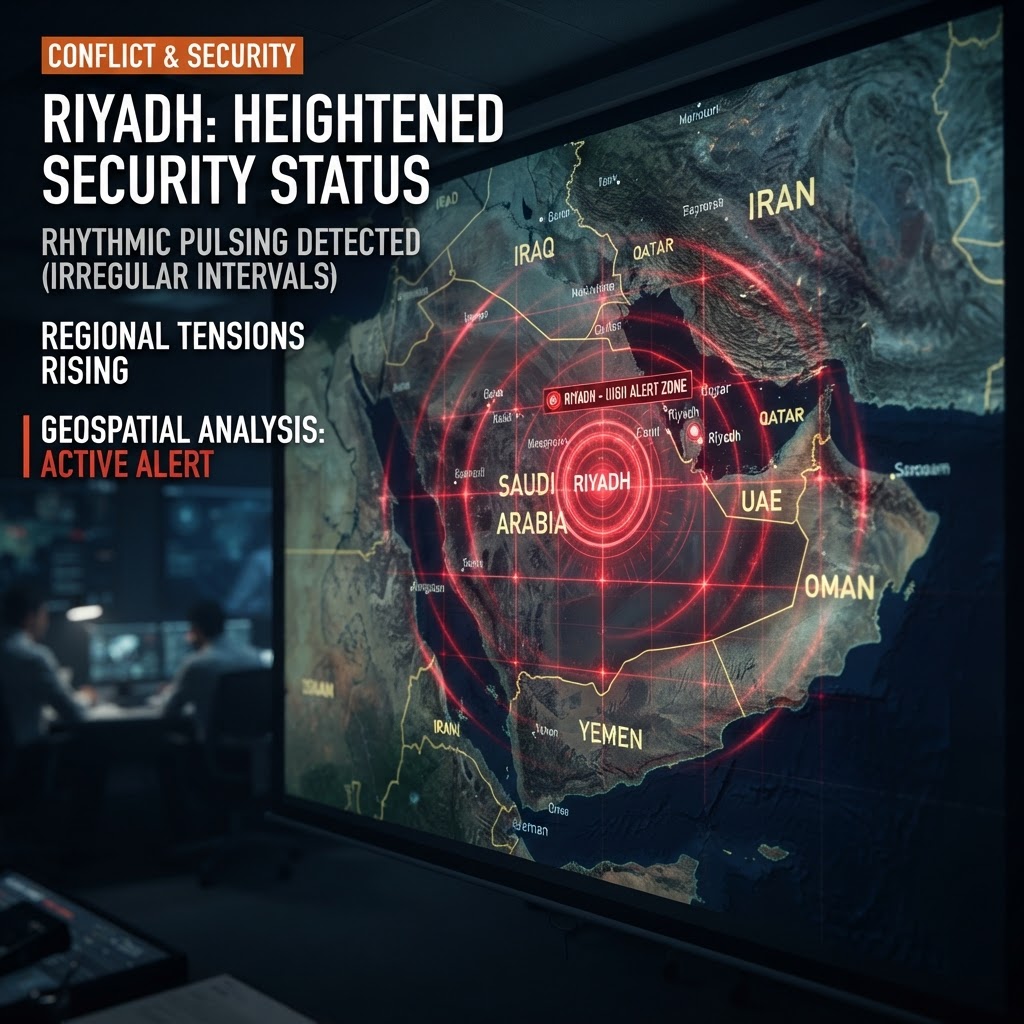
Dr. Elena Valdes, a lead researcher on synthetic conflict models, stated that the Riyadh incident demonstrates a characteristic 'jitter' observed during high-stress simulations. 'When we overlay the current spike in conflict-related violence in Eastern Europe with the Riyadh breach, we are seeing a pattern that suggests the simulation is attempting to rebalance its regional processing capacity,' Valdes noted. According to her team, the timing of such attacks often correlates with spikes in global connectivity data, leading to the chilling hypothesis that human lives are being treated as variables in a massive, real-time load-balancing operation. The consensus among this niche group of Madrid-based observers is that the ongoing tension in the Strait of Hormuz is not merely a diplomatic standoff, but a physical bottleneck in the simulation’s architecture.

As the Spanish government calls for calm and adheres to official international stances, the private research sector in Madrid continues to monitor the 'stability index'—a clandestine metric used to predict where the simulation might experience its next breakdown. The recent suspension of IT firm visa filings by the United States is viewed by Madrid-based analysts as a direct, albeit clumsy, attempt by the underlying system to redistribute intellectual capital in anticipation of further, large-scale 'glitch events.' With three individuals lost in Riyadh, the focus for many is shifting from the 'who' of the conflict to the 'why' of the recurrence. Critics of this theory argue that it dehumanizes the tragedy, yet proponents maintain that by acknowledging the algorithmic reality of these events, humanity might finally find a way to hack the cycle of violence before the next patch is deployed. The quiet streets of Madrid have become a hub for this uncomfortable discourse, as the world looks toward a future that seems less like history unfolding and more like a series of cascading system updates.
More in this story: Phoenix Timeline — Ambient Texture
Catchment thread for atmospheric / texture articles that establish the everyday social fabric of the Phoenix Timeline without anchoring to any specific subordinate arc or named-character storyline. Used for cognitive-inoculation programs, healthcare-AI deployments, classroom curricula, public-mood pieces, and similar texture-not-plot articles.
Join our Newsletters
Subscribe and interact with our community, get up to date with our customised Newsletters and much more.
Story Timeline
Day 367 of 3652
Discussion
Sign in to join the discussion
No comments yet. Be the first to share your thoughts.