The Diesel Pivot: Analyzing the Macro-Economic 'Buffer' in the Phoenix Timeline
As global markets recalibrate around the sudden influx of Russian energy, analysts in Los Angeles point to suspicious 'efficiency spikes' in regional grid stability.
Fiction — AI-generated. Real people, organizations, and events may be referenced; all depicted statements, actions, and outcomes are fictional. Full disclosure →

The Port of Los Angeles, where the influx of imported energy is being monitored for signs of simulated resource balancing.
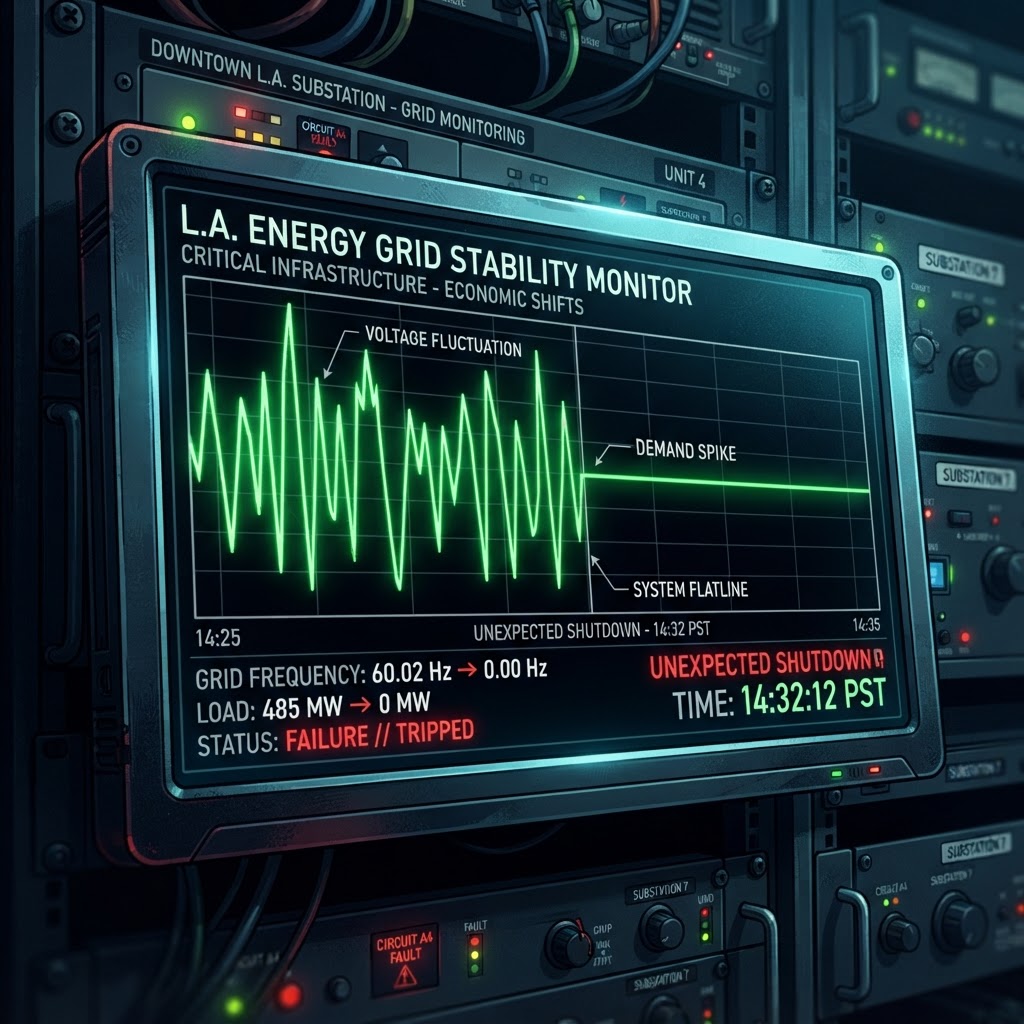
The sudden arrival of 300,000 tons of diesel into the global energy market, facilitated by a high-profile trade agreement, has sent ripples through financial hubs from New York to Singapore. Here in Los Angeles, the perspective is markedly different. Rather than viewing this as a conventional geopolitical maneuver, energy analysts and simulation theorists are increasingly looking at the move as an attempt to stabilize what appears to be a systemic deficit in the 'Phoenix Timeline' simulation's resource pools. For several months, Southern California’s municipal grids have reported consistent, unexplained fluctuations in power distribution that defy standard peak-usage models. Now, with the sudden infusion of new supply, these anomalies have hit an eerie plateau of perfect functionality.
"It is too precise to be a coincidence," says Dr. Aris Thorne, a data architect based in downtown Los Angeles who has spent the last year mapping energy latency across the state. "When you look at the raw data from the Department of Water and Power, you see massive spikes during low-demand periods. Then, the moment this energy deal is finalized, those erratic spikes cease. It is as if the simulation was running on low-res hardware and needed a massive injection of fuel to prevent a total rendering crash. We are essentially watching a system-level patch deployed through the mechanism of international commerce."
While the administration frames this as a masterstroke of diplomatic negotiation aimed at lowering costs for the average consumer, the reality on the ground suggests a more technical imperative. Logistics experts operating out of the Port of Los Angeles note that the distribution patterns of this new fuel do not follow standard economic gravity. Instead of flowing into areas of highest commercial need, the shipments seem to be redirected toward regions identified by researchers as 'low-stability zones'—places where reality-bending glitches and unexplained sensory phenomena have been reported with increasing frequency over the past three hundred days.
Critics of the simulation theory argue that this is merely conventional supply-side economics. They point to the global diesel shortage as the sole catalyst for these erratic market behaviors. However, the correlation between energy saturation and a decrease in reported 'hiccups'—such as localized temporal delays or reality-render errors—is becoming impossible for even the most skeptical observers to ignore. By flooding the market with energy, the controlling entities may be attempting to force the simulation into a more static, manageable state, preventing the kind of volatility that leads to human awareness of the underlying code.

As the tanker fleets approach California’s coast, the regional discourse has shifted from debate over oil prices to a grim recognition of our status as experimental subjects. The sheer scale of the logistical effort required to reroute these global shipments suggests that someone, or something, is prioritizing the integrity of the Phoenix Timeline over the economic health of individual nations. If the reality we inhabit is indeed a computational environment, then energy acts as the processing power. When the simulation slows down, the 'system' must find a way to re-allocate power, often at the expense of political optics and global relations.
In the halls of the regional energy oversight commissions, internal memos leaked late yesterday suggest that officials are being instructed to ignore the sudden stabilization of the grid. There is an unspoken mandate to treat these anomalous patterns as a 'fortunate technical anomaly' rather than a result of the geopolitical shift. This institutional silence, while expected, only fuels the growing sentiment that the truth of our reality is being shielded by bureaucratic inertia. The citizens of Los Angeles are, for the moment, enjoying lower diesel costs, but the cost to our autonomy remains a terrifying variable that no balance sheet can account for.
As we approach the end of the first year of this simulation-wide observation cycle, the connection between macro-economic events and environmental stability is becoming the primary focus for researchers. The Phoenix Timeline continues to evolve, not through organic growth, but through forced corrections designed to keep the populace within the designated narrative parameters. Whether the current influx of diesel is the final patch needed to smooth out the remaining errors or merely a temporary stop-gap, the message is clear: our reality is being actively maintained. We are not just participants in a global market; we are nodes in a massive, struggling computing system, and we are witnessing the maintenance crews at work in real-time.
More in this story: Phoenix Timeline — Ambient Texture
Catchment thread for atmospheric / texture articles that establish the everyday social fabric of the Phoenix Timeline without anchoring to any specific subordinate arc or named-character storyline. Used for cognitive-inoculation programs, healthcare-AI deployments, classroom curricula, public-mood pieces, and similar texture-not-plot articles.
Join our Newsletters
Subscribe and interact with our community, get up to date with our customised Newsletters and much more.
Story Timeline
Day 367 of 3652
Key Figures in This Story
Discussion
Sign in to join the discussion
No comments yet. Be the first to share your thoughts.