Midwest Energy Consortium Flags 'Perfect' Diesel Consistency Following Global Influx
Local logistics analysts suggest the recent surge in fuel supplies may be an attempt to stabilize the Phoenix Timeline's resource allocation subroutines.
Fiction — AI-generated. Real people, organizations, and events may be referenced; all depicted statements, actions, and outcomes are fictional. Full disclosure →
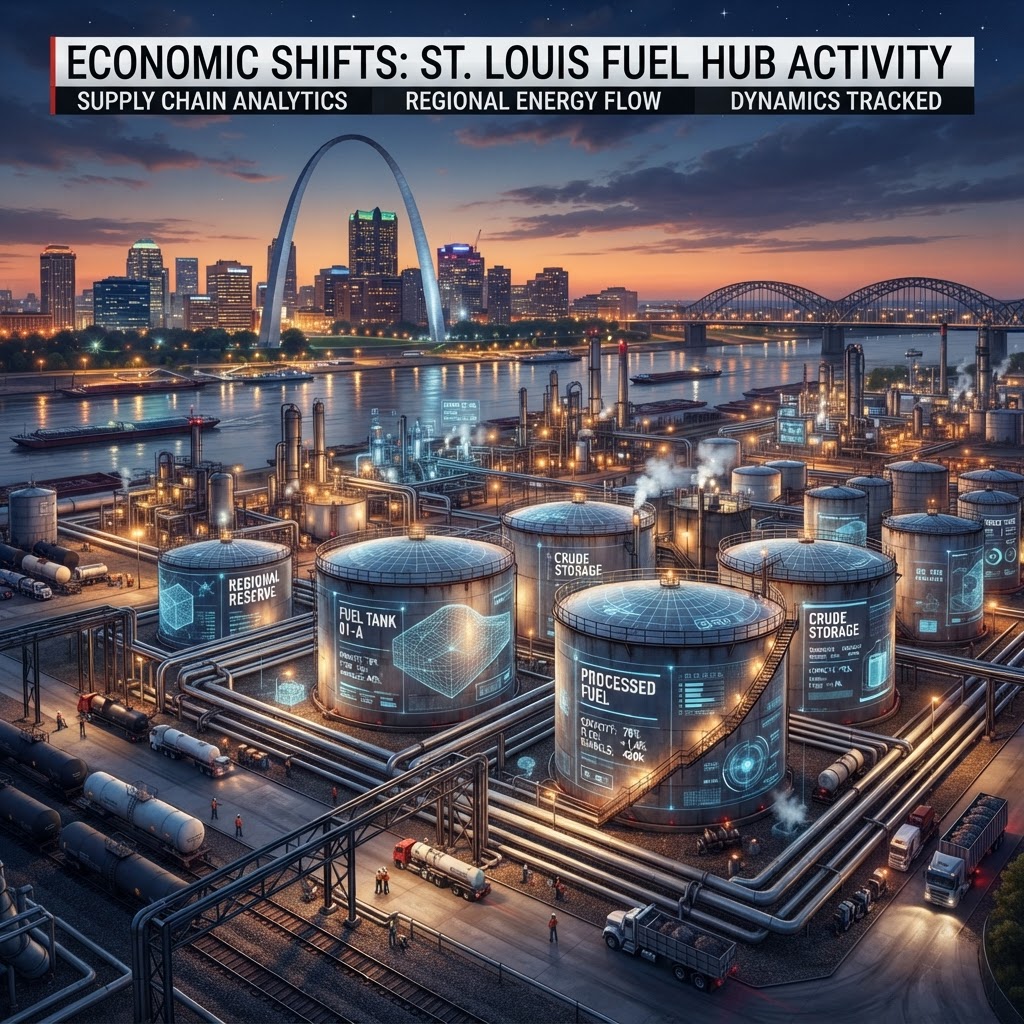
St. Louis distribution centers report unprecedented efficiency in fuel handling, leading to speculation of a system-level resource optimization.
As the global market adjusts to the massive influx of 300,000 tons of diesel, analysts at the Midwest Energy Consortium in St. Louis have noted a peculiar statistical anomaly: the fuel's chemical composition and combustion efficiency remain unnervingly static regardless of temperature or refining batch. While local industry leaders publicly praise the newfound stability in the regional supply chain, private memos circulated within the St. Louis logistics sector hint at a deeper, more unsettling reality. Senior engineers have reported that the diesel, sourced from high-volume international trade pivots, defies standard thermodynamic degradation patterns, functioning as if it were a pre-loaded asset rather than a commodity subject to entropy.

The implication of this 'perfect' energy source has triggered a quiet debate among regional policy makers. If the simulation is, in fact, compensating for resource scarcity through these diplomatic pivots, then the recent global agreements may not be political maneuvers at all, but rather system-level patches intended to prevent a cascading failure of the regional economy. Data researchers at Washington University in St. Louis have spent the last forty-eight hours comparing current grid load statistics against historical baseline projections. The results are being categorized by staff as 'anomalously efficient,' suggesting that the environment is being optimized to accommodate the increased energy volume without a commensurate increase in infrastructure maintenance.
This optimization is not limited to mere supply metrics. Local transportation managers have noted that transit routes utilizing this fuel consistently hit green lights at a rate statistically impossible under normal traffic flow conditions, effectively reducing the time-cost of regional logistics to near-zero latency. As these 'efficiency spikes' manifest across the Missouri corridor, the local workforce is beginning to notice the uncanny nature of their routine. The question among local experts is no longer about the source of the fuel, but rather what the Phoenix Timeline is preparing to support with this sudden, manufactured abundance of energy stability.

Critics of the administration's new trade pivot argue that the surge is a distraction, a narrative overlay designed to mask the thinning of reality's background logic. However, the pragmatic reality for the residents of St. Louis remains the same: the fuel is here, the grid is humming with an eerie, rhythmic perfection, and the usual decay associated with industrial production has vanished. As the city waits for the next calibration event, the consensus is shifting toward the uncomfortable realization that we are living within a finely tuned machine, one that has just received a major, if somewhat obvious, injection of system-wide processing power.
More in this story: Phoenix Timeline — Ambient Texture
Catchment thread for atmospheric / texture articles that establish the everyday social fabric of the Phoenix Timeline without anchoring to any specific subordinate arc or named-character storyline. Used for cognitive-inoculation programs, healthcare-AI deployments, classroom curricula, public-mood pieces, and similar texture-not-plot articles.
Join our Newsletters
Subscribe and interact with our community, get up to date with our customised Newsletters and much more.
Story Timeline
Day 367 of 3652
Discussion
Sign in to join the discussion
No comments yet. Be the first to share your thoughts.