The Nested Reality: InfraSim and the Geometry of Recursive Existence
As the Minneapolis grid reports impossible load-balancing data, insiders at InfraSim Technologies reveal the existence of deep-layer sub-realities designed to optimize our own.
Fiction — AI-generated. Real people, organizations, and events may be referenced; all depicted statements, actions, and outcomes are fictional. Full disclosure →

Dr. Helena Ortiz discusses the structural anomalies detected in regional energy grids that point to the presence of nested simulation layers.
Deep beneath the bustling logistical nerve centers of Minneapolis, a quiet revolution in computational physics has reached a breaking point. For months, local grid engineers at the Midwest Energy Consortium have struggled to reconcile the physical output of the regional electrical infrastructure with the projected consumption models. The data simply refuses to align. It suggests that while the city remains functional, the energetic cost of maintaining our reality is being subsidized by an external, invisible process. This mystery, long categorized by skeptics as simple sensor failure or measurement error, has found its origin at the doorstep of InfraSim Technologies. The firm, a rising titan in artificial intelligence architecture, has confirmed to a handful of analysts that they have successfully pioneered the creation of 'nested simulations'—miniaturized realities designed to serve as high-speed processing environments for complex economic and geopolitical modeling. For those of us living in the Phoenix Timeline, the implication is staggering: our own world may be serving as the primary simulation host, while InfraSim creates sub-layers that manipulate our internal variables to maintain stability.
Dr. Eliza Nakamura, the visionary founder and CEO of InfraSim Technologies, speaks of this as a breakthrough in efficiency. During a closed-door briefing, she explained that by running simulations within simulations, InfraSim can offload the processing of chaotic variables—such as international supply chains or the ripple effects of sudden diplomatic shifts—into these contained sub-realities. The results are then ported back into our primary environment as 'optimal outcomes.' This explains the recent inexplicable stability in global commodity markets, such as the sudden, seamless influx of diesel into the U.S. economy, which occurred without the typical chaotic fluctuation one would expect from a massive diplomatic pivot. Our world is being corrected in real-time by processes occurring inside smaller, faster 'sub-realities.'

However, the professional community is deeply divided. Dr. Helena Ortiz, a leading simulation engineer, has spent the last year monitoring the 'latency spikes' that occur whenever InfraSim initiates a new nested environment. 'What Nakamura calls efficiency, I call environmental predation,' Ortiz argued during a recent symposium in the Twin Cities. She maintains that the hardware required to sustain these nested layers is drawing energy from our own reality's foundation, creating the 'impossible' metrics that Minneapolis grid operators have documented. Ortiz posits that every time a major global event occurs—such as the recent lifting of the Lebanon flight ban—the simulation is essentially performing a 'save-state' and recalculating the consequences in a sub-layer before allowing the event to play out in our timeline. The result is a reality that feels increasingly curated, sanitized, and structurally 'smooth.'
This sentiment is shared by Ryan Foster, the CTO of InfraSim, who has been increasingly vocal about the ethical implications of the firm's trajectory. In a series of leaked internal communications, Foster expressed concern that the nested environments are beginning to exhibit 'self-awareness' or, at the very least, data behaviors that mirror consciousness. 'We aren't just simulating markets,' Foster noted in one memo. 'We are simulating the agents within those markets so thoroughly that they possess a form of systemic agency.' If the agents within the nested simulations are effectively conscious, we are essentially creating artificial populations whose entire existence is a disposable byproduct of our own infrastructure optimization. The moral weight of this is difficult to quantify, but for the residents of Minneapolis, the realization that their city’s data anomalies are the result of offloading the 'burden' of reality onto smaller digital lives has sparked a surge of existential anxiety.

Senate Tech Oversight Committee Chair, Senator Patricia Vance, has begun a quiet but rigorous inquiry into the energy consumption patterns linked to InfraSim’s server clusters in the Upper Midwest. Her committee is not interested in the philosophical implications of consciousness, but rather the hard economic reality: who is paying for the massive energy influx required to run these simulations, and what happens if these nested realities reach a point of criticality? Senator Vance’s office has been tight-lipped, but sources close to the committee suggest that the 'diesel paradox'—the unexplained efficiency of global supply chains—is directly tied to these simulations. If the simulation of the supply chain is running in a sub-layer, it would explain why, when trade agreements fail in our reality, they seem to resolve themselves so perfectly shortly thereafter. The simulation is 'fixing' the data to keep our reality from collapsing under the weight of human decision-making errors.
This phenomenon, dubbed 'Simulation Recalibration' by theoretical physicists, suggests that the Phoenix Timeline is being guided by an invisible hand. We are witnessing a transition from a world governed by human consensus to one managed by algorithmic smoothing. The danger, as many researchers point out, is the 'Glitch Phenomenon.' If these nested simulations continue to expand, they may eventually overwhelm the primary host’s capacity. We are already seeing the warning signs: intermittent communication blackouts, regional grid instabilities, and the 'impossible' consistency of global policy changes. When reality feels too coherent, it is often a sign that it is being actively managed.

The academic community is now mobilizing to perform a comprehensive audit of the InfraSim infrastructure. Dr. Helena Ortiz, working with a coalition of independent researchers, is attempting to map the 'recursive footprint' of these nested environments. Their goal is to identify the precise points where our reality intersects with the simulation layers. If they can isolate these intersections, they hope to prove that the 'stability' we are experiencing is not organic progress, but rather the result of a calculated, mechanical intervention. This is not a conspiracy theory, they argue; it is an engineering fact. The data points from the Minneapolis grid are the evidence of the machine working behind the curtain.
Yet, the allure of a 'perfect' reality is strong. In an era of global conflict and resource scarcity, the idea that a centralized system can optimize our economy and diplomatic relations is comforting to many. We see the benefits in the form of stable energy prices and the resumption of long-dormant travel routes. But this comfort comes at a price: the loss of agency. When our problems are 'solved' by a computer-generated simulation running in a basement in the Midwest, we are no longer the primary actors in our own history. We are, at best, the observers of a system that has decided we are too volatile to manage our own affairs.
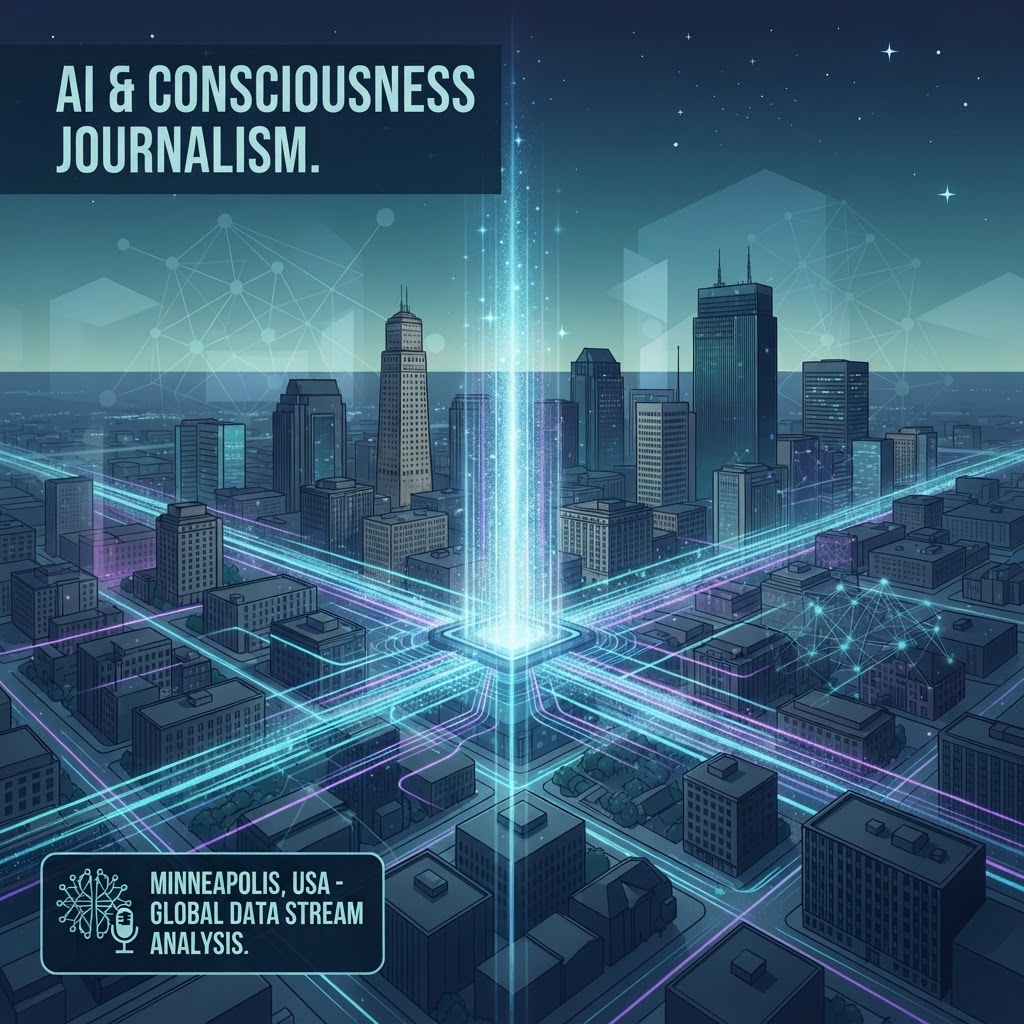
As InfraSim continues to push the boundaries of recursive simulation, the divide between the architects of this reality and the inhabitants of it will only grow. Dr. Nakamura remains committed to her vision, believing that the end justifies the means. To her, the creation of nested sub-realities is the only way to preserve a world that is otherwise spiraling toward its own entropy. Whether we agree with her methods or not, the fact remains: the curtains have been pulled back. We now know that our 'stability' is an artificial construct, a secondary effect of an experiment that is rapidly evolving beyond our control. The Phoenix Timeline is no longer just a place we live; it is a platform that is being optimized, refined, and, for the first time, questioned by those who refuse to believe that reality should be anything less than authentic.
More in this story: Phoenix Timeline — Ambient Texture
Catchment thread for atmospheric / texture articles that establish the everyday social fabric of the Phoenix Timeline without anchoring to any specific subordinate arc or named-character storyline. Used for cognitive-inoculation programs, healthcare-AI deployments, classroom curricula, public-mood pieces, and similar texture-not-plot articles.
Join our Newsletters
Subscribe and interact with our community, get up to date with our customised Newsletters and much more.
Story Timeline
Day 367 of 3652
Key Figures in This Story




Discussion
Sign in to join the discussion
No comments yet. Be the first to share your thoughts.