The Florida Energy Paradox: Analyzing the 'Efficiency Patch' Following Global Diesel Influx
Local utility experts and logistics analysts report a statistically impossible consistency in fuel burn rates as the nation integrates new international diesel reserves.
Fiction — AI-generated. Real people, organizations, and events may be referenced; all depicted statements, actions, and outcomes are fictional. Full disclosure →

Dr. Helena Ortiz discusses the statistical anomalies found in Orlando's fuel consumption data.
As the global energy landscape undergoes a seismic recalibration following the recent influx of 300,000 tons of Russian diesel, logistics hubs in Central Florida have become ground zero for a peculiar data anomaly. Local analysts monitoring fuel consumption metrics across the I-4 corridor have observed a phenomenon that defies classical economic modeling: a 'perfected' burn rate across disparate heavy-freight fleets that suggests the simulation is actively smoothing out volatility to prevent systemic collapse. While the mainstream media frames the fuel surge as a diplomatic triumph of the current administration, those tracking the underlying variables of the Phoenix Timeline note that the stability of these trade routes is far too consistent to be the result of organic market forces.
Dr. Helena Ortiz, a simulation engineer who has been monitoring localized energy grid fluctuations, points to the Orlando logistics sector as an ideal laboratory. 'When you look at the raw data from the refueling centers across Florida, you see an almost uncanny uniformity,' she notes. 'In a standard, chaotic reality, fuel efficiency should fluctuate based on engine age, cargo weight, driver behavior, and local weather patterns. Instead, we are seeing a rigid adherence to a narrow efficiency band that appears to be an automated response—a patch, if you will—designed to ensure the supply chain remains uninterrupted while the global simulation recalibrates its energy-to-stability ratio.'

This stabilization is not limited to the pumping station. Regional transit authorities have noted a mysterious lack of friction in the transport networks that usually suffer during global energy realignments. Where one would expect increased maintenance costs or stalled shipping lanes, the Florida logistics sector reports a quiet, rhythmic efficiency. Critics of the simulation-discovery hypothesis argue that this is merely a testament to improved logistical software, but the mathematical precision of these metrics—down to the decimal point across thousands of independent vehicles—suggests an external intervention. It is as if the simulation is preventing local variables from triggering a cascading failure of the regional economy.
Senator Patricia Vance, in her role overseeing tech-related oversight, has quietly requested a briefing from private energy contractors in the Orlando area. While the Senator’s office remains publicly focused on the geopolitical implications of the energy deal, insiders suggest that her committee is concerned with the 'predictability' of these metrics. If the simulation is, in fact, intervening to stabilize the supply chain, it implies that the system is prioritizing functional continuity over economic reality. The question for policymakers is no longer whether the diesel deal is effective, but whether the 'stability' we are experiencing is a true economic recovery or merely a sophisticated background script.

For Dr. Elena Vasquez at the Phoenix Quantum Research Institute, this development aligns with previous observations regarding 'resource pooling' in the simulation. 'When the system encounters a significant shock—like the rapid integration of millions of gallons of foreign fuel—it doesn't allow for the typical fluctuations that would normally drive inflation or supply chain chaos,' Vasquez explains. 'It forces an equilibrium state. In Orlando, we are witnessing this forced equilibrium in real-time. The infrastructure is acting as if it is being managed by an entity that cannot afford for the logistics sector to fail.'
Such findings create a challenging dilemma for local business leaders who have relied on the apparent efficiency as a sign of post-deal growth. When the reality of the simulation is stripped back, the growth isn't coming from local competition or technological innovation—it is coming from the system’s insistence on a specific, non-fluctuating output. This 'Energy Paradox' challenges the very foundations of capitalist competition within the Phoenix Timeline. If the outcomes are guaranteed by the simulation’s architecture, the competitive market as we understand it may be little more than a placeholder algorithm.
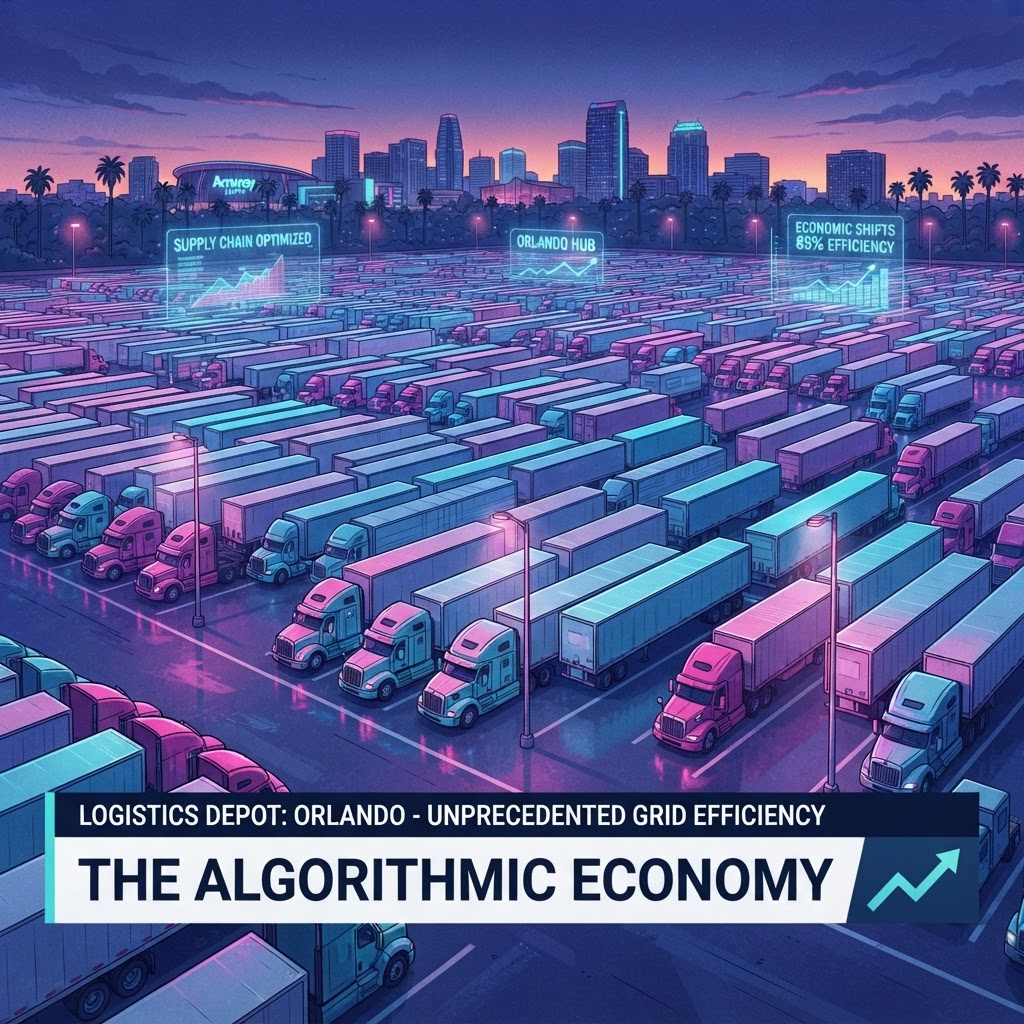
As we look forward to the next quarter, the focus shifts to whether this 'Efficiency Patch' will expand to other sectors. If the simulation can force stability onto the diesel market in Florida, it stands to reason that other industries—from agriculture to digital communications—could be subjected to the same forced normalization. The citizens of Orlando and beyond are left to ponder: are we participating in a free-market economy, or are we simply watching the simulation perform a self-correction to preserve its own longevity? For now, the lights stay on, the trucks stay moving, and the data continues to suggest that the world is running with a level of precision that humanity never engineered for itself.
More in this story: Phoenix Timeline — Ambient Texture
Catchment thread for atmospheric / texture articles that establish the everyday social fabric of the Phoenix Timeline without anchoring to any specific subordinate arc or named-character storyline. Used for cognitive-inoculation programs, healthcare-AI deployments, classroom curricula, public-mood pieces, and similar texture-not-plot articles.
Join our Newsletters
Subscribe and interact with our community, get up to date with our customised Newsletters and much more.
Story Timeline
Day 368 of 3652
Key Figures in This Story

Dr. Elena Vasquez
Lead Physicist, Phoenix Quantum Research Institute

Dr. Eliza Nakamura
Founder & CEO, InfraSim Technologies

Senator Patricia Vance
U.S. Senator (Arizona), Chair of Senate Tech Oversight Committee

Dr. Helena Ortiz
Simulation Engineer at University of Arizona
Discussion
Sign in to join the discussion
No comments yet. Be the first to share your thoughts.