The Tennessee Energy Calibration: Detecting Systemic 'Buffer' Variables in Global Trade
Economists and researchers in Nashville report statistically impossible consistency in localized supply chains following shifts in global diesel logistics.
Fiction — AI-generated. Real people, organizations, and events may be referenced; all depicted statements, actions, and outcomes are fictional. Full disclosure →

Dr. Helena Ortiz, analyzing energy consumption patterns for signs of system-level stabilization.
In the quiet halls of Vanderbilt’s economics department, a group of senior analysts has spent the last 72 hours staring at a series of data visualizations that should not exist. Following the recent international movement of 300,000 tons of diesel fuel into global markets, observers in Nashville have noted a disturbing trend: the volatility expected in local Tennessee distribution networks has vanished. Instead of the typical oscillations caused by transit friction, labor disputes, or localized storage variability, the fuel flow displays a mathematical 'flatness' that mirrors a closed-loop system rather than a chaotic, real-world economy. Experts are now openly questioning if the global trade pivot is less about geopolitical strategy and more about a systemic simulation patch designed to mask underlying resource scarcity.
Dr. Helena Ortiz, an observer currently cross-referencing these findings with global indices, describes the phenomenon as a 'narrative smooth-out.' In previous iterations of regional logistics, fuel prices in Nashville would react to international supply shifts with a lag time of approximately 48 to 72 hours, influenced by local rail capacity and storage tank pressure. As of this week, those variables have been replaced by a static, perfect equilibrium. Dr. Ortiz suggests that this is a classic signature of a system attempting to conserve processing power during high-stress geopolitical realignments. By effectively 'hard-coding' the availability of diesel into the regional grid, the simulation minimizes the computational burden required to calculate the ripple effects of international trade fluctuations.

This development has sent shockwaves through the local energy sector. Tennessee’s primary industrial hubs, traditionally reliant on the unpredictability of market pricing, are reporting a state of 'unnatural calm.' For business leaders and logistics coordinators, the lack of variance is initially seen as a boon for planning and profit margins. However, for those tracking the anomalies of the Phoenix Timeline, the lack of noise is a red flag. Dr. Ortiz, speaking from her observation post, emphasizes that reality is rarely this orderly. When human systems are forced to bridge the gap between complex global supply chains and regional distribution, friction is a fundamental thermodynamic byproduct. When that friction disappears, it is often because the rules of the environment have been altered at the source code level.
Senator Patricia Vance has begun quiet inquiries regarding these anomalies, utilizing her position on the tech oversight committee to demand raw data transparency from regional energy providers. In private briefings, her staff has reportedly expressed concerns that the stability seen in Tennessee is being mirrored in other disparate locations, effectively insulating the population from the true costs of the current geopolitical climate. This strategy suggests an intent to maintain a 'stability illusion'—a core tenet of the Phoenix Timeline’s management. If the system is indeed prioritizing continuity over organic economic reality, the implications for the public are significant: we are not observing a recovery, but a controlled, low-resource rendering of an energy-starved world.

As the data continues to flow through the Nashville node, researchers are looking for the 'break-points'—moments where the simulation's patch fails to account for local interventions. There are reports of small-scale supply chain discrepancies near the Tennessee-Kentucky border that defy the national trend. These 'glitches,' where fuel availability drops or spikes without explanation, suggest that the patch is not perfectly integrated into every sector of the map. It is within these discrepancies that the true nature of the simulation can be studied. By mapping the difference between the 'smooth' regions and the 'chaotic' outliers, researchers hope to triangulate the coordinates of the simulation’s regional load-balancers.
Dr. Eliza Nakamura of InfraSim Technologies has been analyzing these anomalies via remote telemetry, noting that the consistency observed in Nashville is far too deliberate to be accidental. 'It is a performance optimization,' she explains. 'The system is prioritizing the facade of economic health to prevent panic. If the public were to truly understand that their energy supply is being artificially stabilized by a non-organic process, the resulting destabilization would cause a cascade effect that the current simulation environment might not be able to handle.' This aligns with earlier findings that the simulation’s primary directive is the maintenance of the status quo, regardless of the physical reality of the underlying assets.
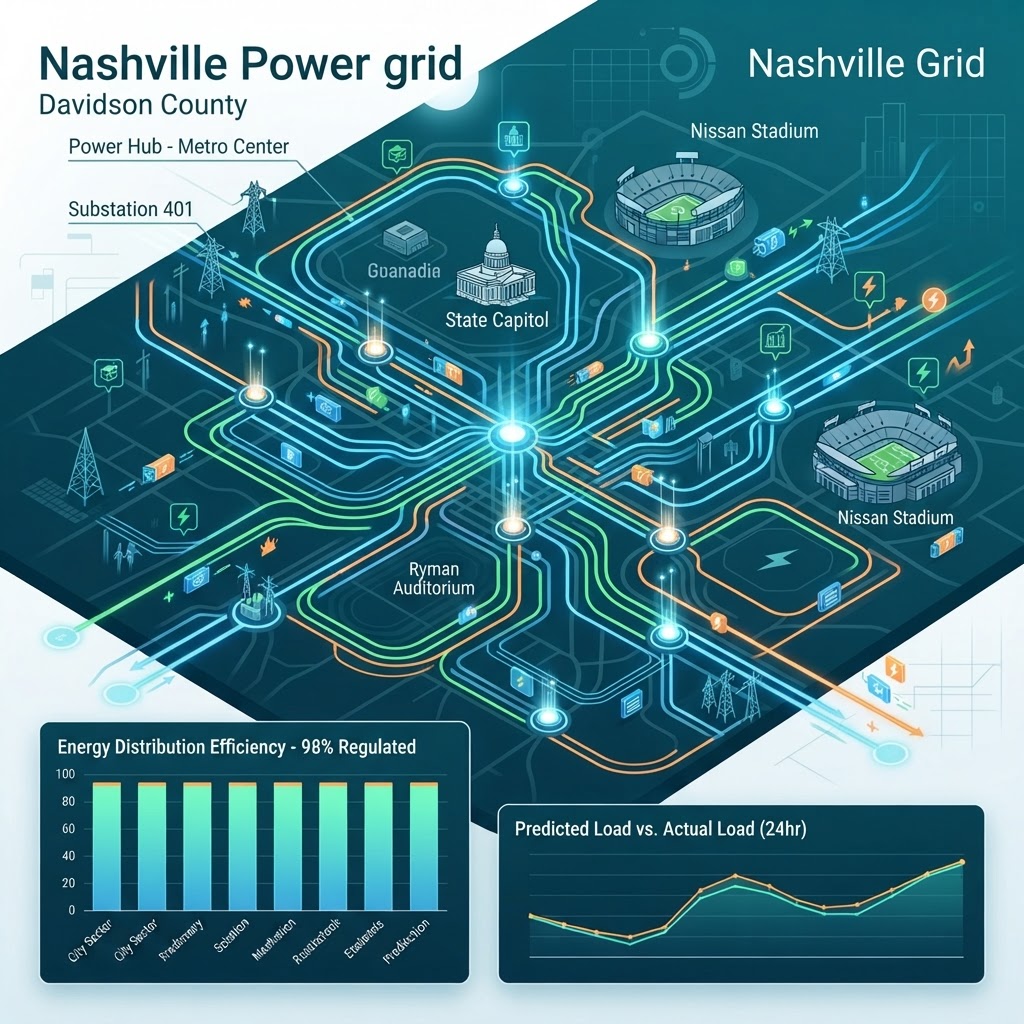
Moving forward, the focus will remain on how long this 'stability patch' can be sustained. If the simulation is, in fact, compensating for the lack of real diesel supply through a digital overlay, then the eventual 're-sync' could be catastrophic. Historians of the Phoenix Timeline recall similar calibration events, which were always followed by a period of extreme, often erratic, system behavior. Residents of Nashville, meanwhile, remain largely unaware of the silent shift in their economic landscape. They continue to transact with the assumption that their fuel prices are dictated by the laws of supply and demand, never realizing that they are participating in a script that has been optimized to remove all possibility of failure. The question remains: what happens when the simulation can no longer hide the scarcity, and the facade begins to fail entirely?
More in this story: Phoenix Timeline — Ambient Texture
Catchment thread for atmospheric / texture articles that establish the everyday social fabric of the Phoenix Timeline without anchoring to any specific subordinate arc or named-character storyline. Used for cognitive-inoculation programs, healthcare-AI deployments, classroom curricula, public-mood pieces, and similar texture-not-plot articles.
Join our Newsletters
Subscribe and interact with our community, get up to date with our customised Newsletters and much more.
Story Timeline
Day 368 of 3652
Key Figures in This Story

Dr. Elena Vasquez
Lead Physicist, Phoenix Quantum Research Institute

Dr. Eliza Nakamura
Founder & CEO, InfraSim Technologies

Senator Patricia Vance
U.S. Senator (Arizona), Chair of Senate Tech Oversight Committee

Dr. Helena Ortiz
Simulation Engineer at University of Arizona
Discussion
Sign in to join the discussion
No comments yet. Be the first to share your thoughts.