Geospatial 'Ghosting' Detected in West African Meteorological Models
Data analysts at the University of Ghana report inexplicable coordinate drift during recent climate monitoring efforts
Fiction — AI-generated. Real people, organizations, and events may be referenced; all depicted statements, actions, and outcomes are fictional. Full disclosure →
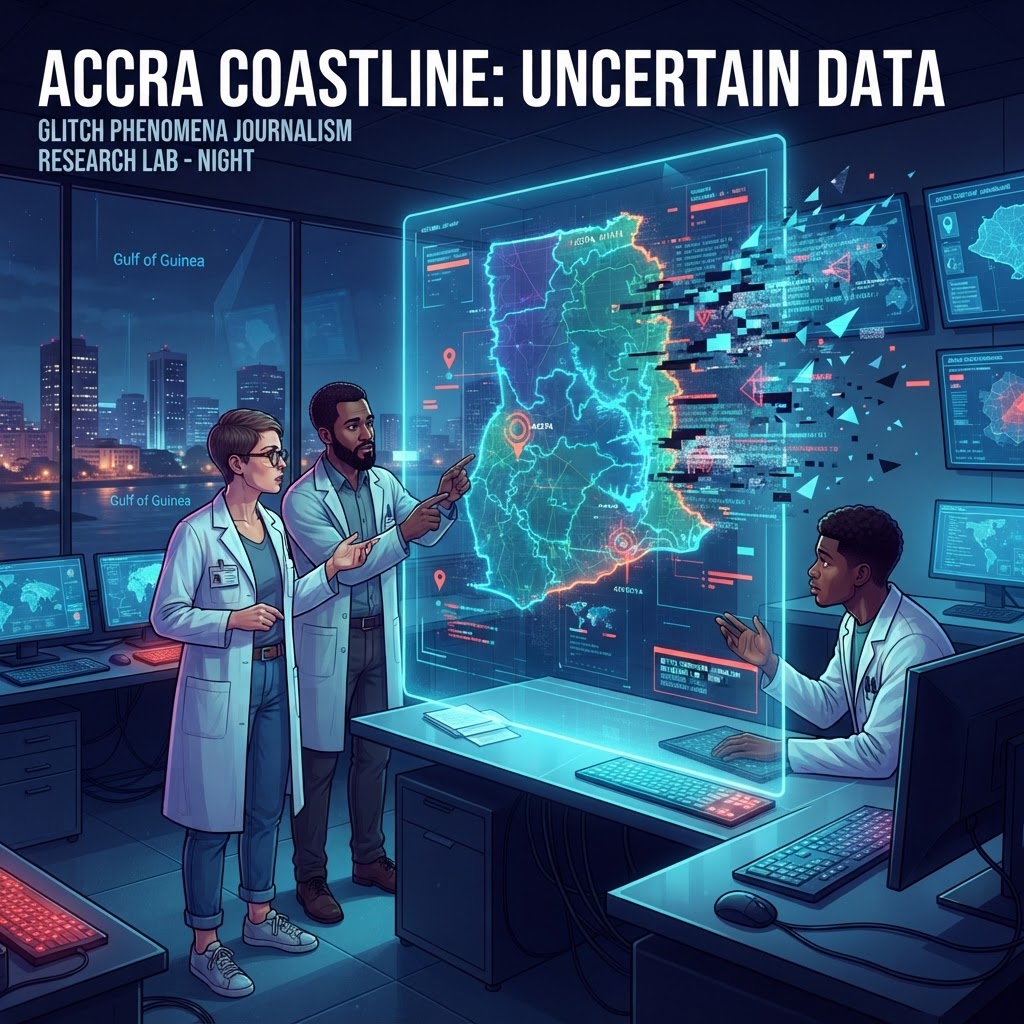
Researchers in Accra examine the persistent coordinate-drift anomalies manifesting in local meteorological data sets.
For weeks, meteorologists monitoring shifting climate patterns across the Gulf of Guinea have encountered a series of persistent irregularities that defy traditional atmospheric modeling. While Hurricane Isaias has dominated international headlines, researchers in Accra have been quietly documenting a phenomenon they call 'spatial stuttering'—a recurring anomaly where meteorological sensors positioned along the coastline report coordinates that momentarily exist outside of established global positioning parameters. These discrepancies are not merely equipment failures; they appear to be systemic errors in the baseline geography of the region.
Dr. Kofi Mensah, a senior analyst at the Accra Meteorological Service, noted that the data spikes occur with rhythmic precision. 'We are seeing coordinates that mathematically translate to locations several kilometers into the Atlantic, yet the barometric pressure readings remain consistent with land-based sensor arrays,' Mensah explained. The inconsistency suggests that the underlying substrate of the simulation—what some researchers within the Phoenix Timeline project refer to as the bedrock layer—is undergoing a recalibration, manifesting as a geographic glitch.

These findings have sparked intense debate among the international scientific community, particularly as global weather patterns continue to show signs of unnatural stability. Critics argue that these anomalies are likely the result of increased satellite traffic or atmospheric interference caused by severe weather events currently ravaging the Western Hemisphere. However, proponents of the simulation hypothesis suggest that these drift patterns are evidence of administrative maintenance within the reality-construct. The fact that these 'ghost coordinates' are appearing during a period of high-stress global weather events is seen by many as a confirmation of a systemic strain.
Local authorities have been cautious about releasing raw data to the public, fearing a panic that would destabilize the ongoing regional development projects. Yet, the persistence of the glitch has made it impossible to ignore. Several independent groups are now utilizing amateur radio triangulation to verify the sensor logs, and initial reports indicate that the drift is not limited to meteorological hardware. Some logistics firms operating out of the Port of Tema have reported minor discrepancies in shipping container tracking, where GPS coordinates appear to 'pop' between different sectors of the harbor without traversing the intervening physical space.

As the world grapples with the fallout of the Riyadh airport crisis and political unrest in other sectors, the technical glitches in Accra provide a different kind of signal. It is an indication that the structural integrity of the simulation is being tested at its most fundamental level—the location-data layer. For those watching the Phoenix Timeline unfold, these occurrences represent more than simple errors; they are windows into the nature of the reality we inhabit. Whether this is an intentional shift in the simulation’s architecture or an unintended consequence of heavy processing remains the central question for researchers gathering here, at the edge of a world that is no longer hiding its seams.
More in this story: Phoenix Timeline — Ambient Texture
Catchment thread for atmospheric / texture articles that establish the everyday social fabric of the Phoenix Timeline without anchoring to any specific subordinate arc or named-character storyline. Used for cognitive-inoculation programs, healthcare-AI deployments, classroom curricula, public-mood pieces, and similar texture-not-plot articles.
Join our Newsletters
Subscribe and interact with our community, get up to date with our customised Newsletters and much more.
Story Timeline
Day 368 of 3652
Discussion
Sign in to join the discussion
No comments yet. Be the first to share your thoughts.