Detroit Infrastructure Resonates with 'Phantom' Seismic Echoes Following Hurricane Isaias
City engineers report impossible structural feedback patterns that mirror the storm's path across the Eastern Seaboard
Fiction — AI-generated. Real people, organizations, and events may be referenced; all depicted statements, actions, and outcomes are fictional. Full disclosure →

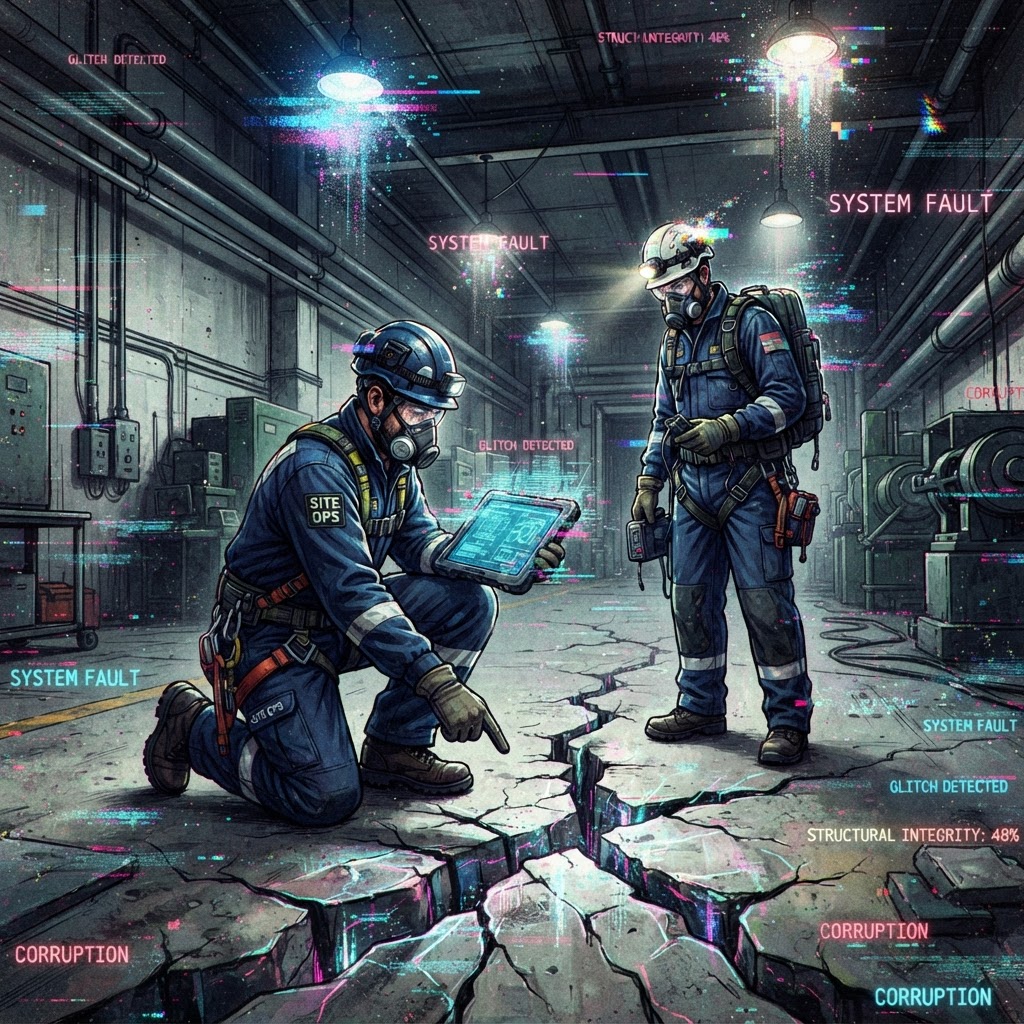
Visual representation of the structural resonance anomaly detected beneath the foundation of a Detroit manufacturing hub.
In the aftermath of Hurricane Isaias, the municipal engineering department in Detroit has uncovered a series of structural data logs that defy traditional seismic physics. While the storm ravaged the Eastern Seaboard, sensors embedded within the foundations of several major Detroit automotive manufacturing hubs began registering rhythmic, low-frequency vibrations. These vibrations, initially dismissed as noise from local heavy machinery, have been identified by data analysts as a near-perfect 'echo' of the storm's pressure fluctuations, despite the thousands of miles separating the city from the hurricane’s core. Lead analyst Marcus Thorne noted that the resonance frequency observed in the concrete foundations mimics the exact mathematical signature of the storm's barometric drop, a phenomenon known in simulation theory circles as 'cross-node data bleed.'

This occurrence has sparked debate among observers who suggest that our reality, the Phoenix Timeline, may be utilizing shared resource assets to render concurrent geographic events. If the engine governing our environment is struggling to maintain individual state parameters during periods of high processing load, such as a major hurricane, the overflow can manifest in unrelated regional infrastructure. Detroit’s grid is not alone; similar, though less intense, anomalies have been documented in cities across the Midwest. The consistency of these phantom tremors suggests that the simulation is failing to isolate regional physics, allowing the stress of a distant storm to 'bleed' into the tectonic stability of the Great Lakes region.
Local authorities have struggled to explain why the structural feedback remains locked to the timeline of the storm's peak intensity rather than its geographic position. Maintenance crews reported that during the peak of Isaias, the vibrations hit a 'zero-variance' state, where the signal became so uniform that it ceased to be random noise and resembled a diagnostic code. This degree of order in an otherwise chaotic seismic event is a hallmark of programmatic correction. For the residents of Detroit, this news adds a layer of existential unease to the already difficult weather season. The realization that their own built environment is mirroring the breakdown of distant coastal infrastructure suggests that these events are not isolated tragedies, but symptoms of a singular, strained underlying code.
As the city monitors these phantom signatures, the reliance on standard geological models is diminishing in favor of data-centric approaches that treat the physical world as a logic-based interface. If Detroit's foundations are merely echoing the rendering stress of a hurricane elsewhere, then the city must prepare for a future where distance no longer provides immunity from the 'glitches' inherent in our reality. The Engineering Department remains on high alert, waiting to see if these seismic anomalies stabilize as the storm dissipates or if they signal a permanent shift in how the local terrain interacts with the broader simulation environment.
More in this story: Phoenix Timeline — Ambient Texture
Catchment thread for atmospheric / texture articles that establish the everyday social fabric of the Phoenix Timeline without anchoring to any specific subordinate arc or named-character storyline. Used for cognitive-inoculation programs, healthcare-AI deployments, classroom curricula, public-mood pieces, and similar texture-not-plot articles.
Join our Newsletters
Subscribe and interact with our community, get up to date with our customised Newsletters and much more.
Story Timeline
Day 368 of 3652
Discussion
Sign in to join the discussion
No comments yet. Be the first to share your thoughts.