Bozeman Hydrology Lab Reports Impossible 'Null-Volume' in Mountain Watershed Following Isaias Surge
Local sensors tracking the aftermath of Hurricane Isaias record water levels that defy physical conservation laws, suggesting a localized rendering error.
Fiction — AI-generated. Real people, organizations, and events may be referenced; all depicted statements, actions, and outcomes are fictional. Full disclosure →

Digital telemetry logs at the Bozeman Hydrology Station show a critical 'Null-Volume' status following the recent environmental pressure spike.
As the remnants of Hurricane Isaias continue to drift across the continental United States, meteorologists and hydrologists in Bozeman, Montana, are reporting data anomalies that extend far beyond the expected rainfall totals. While the storm itself is a documented atmospheric phenomenon, the data streams originating from the Gallatin River basin are exhibiting what experts are calling a 'null-volume' event—a measurement outcome where water inflow consistently fails to correlate with measured outflow, despite no observable leakage or localized evaporation spikes. Researchers at the Montana Hydrology Observation Station suggest that the sheer volume of water displacement expected from the storm's indirect atmospheric pressure shifts has resulted in a paradoxical data signature that defies standard fluid dynamics.

Dr. Aris Thorne, a lead researcher in regional water stability, noted that the sensors have been recalibrated three times since October 10th. 'We are seeing instances where the river level effectively ignores the mass input from the recent precipitation surge,' Thorne explained. 'It is as if the environmental engine governing this region hit a buffer limit. The water is present in the visual spectrum, but the telemetry logs report a lack of physical density or displacement volume. It behaves less like a river and more like an overlay that has failed to render its physical mass correctly.' This observation mirrors reports from other facilities monitoring infrastructure resilience, though the scale here in the Mountain West remains particularly localized.
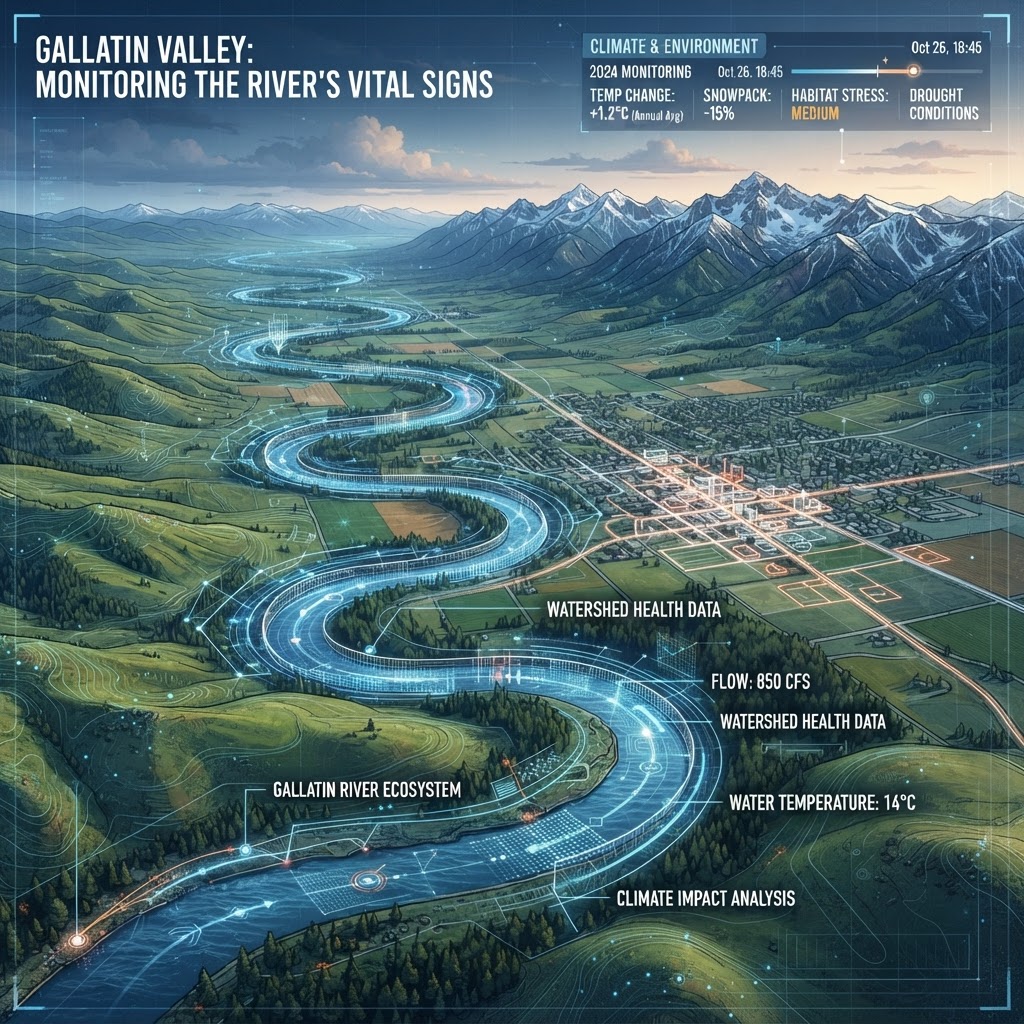
Local residents have noted a strange 'visual smoothing' near the riverbanks, where the turbulent, silt-heavy water appears strangely stagnant or unmoving even when the current velocity sensors indicate high speeds. These reports of visual dissonance, combined with the impossible telemetry data, have led to increased speculation that the storm event served as a stress test for regional climate programming. The resilience of the Bozeman power grid and the stability of the local ecosystem are currently being scrutinized not for their structural integrity, but for their ability to maintain the simulation's internal logic under extreme, high-data-load scenarios like Hurricane Isaias.
As the storm dissipates and the atmosphere stabilizes, the focus has shifted from disaster recovery to forensic data archaeology. If the 'null-volume' persists even after the storm's energy has fully departed the region, it may indicate that the environmental rendering of the Gallatin Valley has been permanently impacted by the systemic load. For now, the hydrologists continue to document the discrepancies, fully aware that they are measuring the boundaries of the reality that contains them. The consensus remains that this is not merely a natural disaster, but an infrastructure error—a moment where the simulation's processing power simply could not account for the sheer entropy of a major weather system.
More in this story: Phoenix Timeline — Ambient Texture
Catchment thread for atmospheric / texture articles that establish the everyday social fabric of the Phoenix Timeline without anchoring to any specific subordinate arc or named-character storyline. Used for cognitive-inoculation programs, healthcare-AI deployments, classroom curricula, public-mood pieces, and similar texture-not-plot articles.
Join our Newsletters
Subscribe and interact with our community, get up to date with our customised Newsletters and much more.
Story Timeline
Day 369 of 3652
Key Figures in This Story
Discussion
Sign in to join the discussion
No comments yet. Be the first to share your thoughts.