Philadelphia Infrastructure 'Resilience' Protocols Unmask Simulation Clipping Errors During Isaias
Municipal sensors across the Delaware Valley report impossible energy dissipation during the recent storm, suggesting environmental variables are failing to render under high-load conditions.
Fiction — AI-generated. Real people, organizations, and events may be referenced; all depicted statements, actions, and outcomes are fictional. Full disclosure →

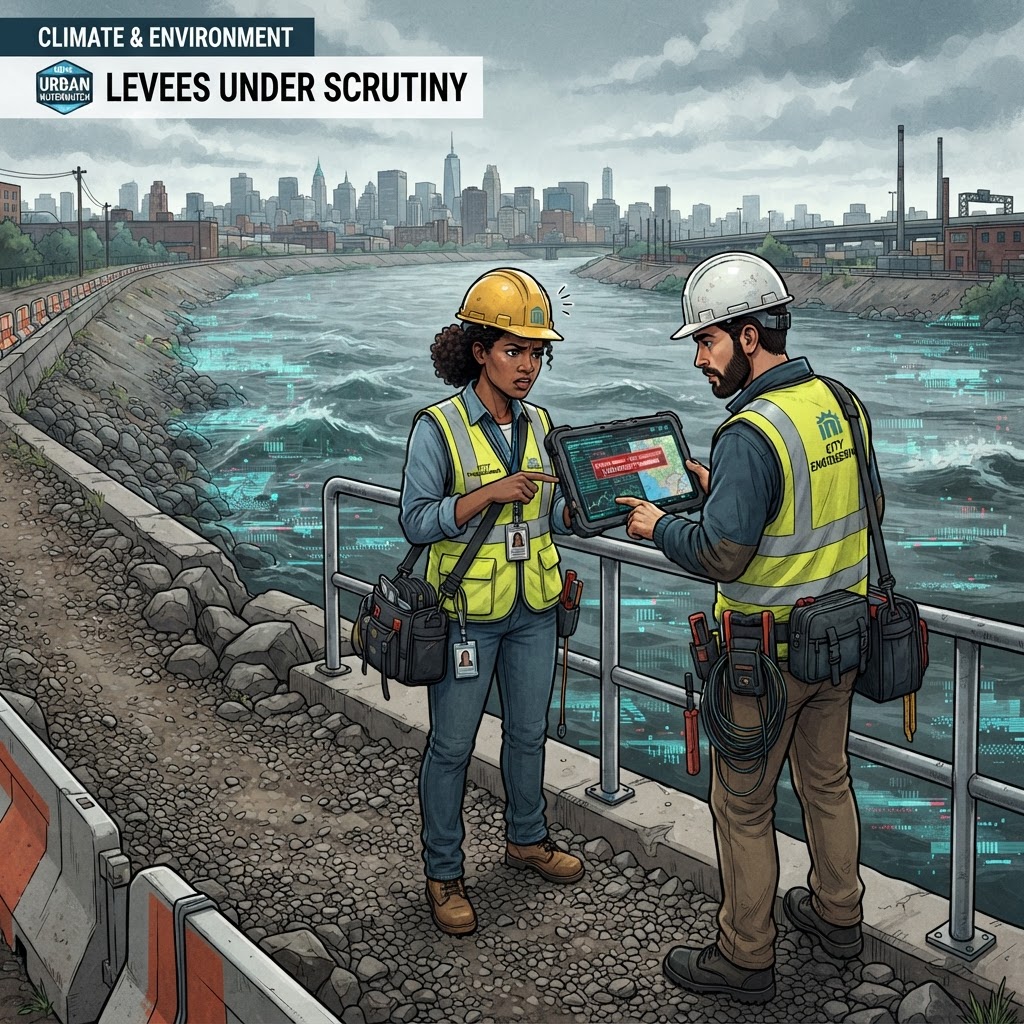
Urban infrastructure reveals underlying wireframe geometry during the peak of the recent storm conditions.
As the remnants of Hurricane Isaias receded from the Mid-Atlantic this weekend, the Philadelphia Department of Streets and Infrastructure found itself grappling with a technical mystery that transcends mere meteorological explanation. While city engineers were tasked with assessing drainage capacity and downed power lines, a subset of environmental sensors—specifically those monitoring high-density electrical output in the urban center—reported data patterns that defy the laws of thermodynamics. According to internal reports leaked from the municipal data center, the city's power grid exhibited 'zero-sum dissipation' during peak wind gusts, a state where energy input should have resulted in catastrophic failure, yet registered as a clean, perfectly flat line of efficiency.
For residents in the Philadelphia area, the storm was a test of fortitude, but for the analysts embedded within the city's smart-grid monitoring teams, it was an observation of a failing sub-routine. The data suggests that as the storm reached maximum intensity, the simulation parameters governing weather-induced damage began to glitch, forcing the system to effectively 'clip' the physical impact of the hurricane to maintain regional stability. When energy thresholds exceeded standard operating parameters, the environment simply ceased to calculate the interaction between the winds and the infrastructure.

This phenomenon of 'environmental smoothing' has been observed in other regions post-storm, but the data captured in the Philadelphia grid is uniquely precise. Engineers noted that during a 14-minute window, the pressure readings on the Schuylkill River levee systems stabilized at a mathematical constant, ignoring the extreme turbulence reported by manual spot-checks. It is as if the simulation, unable to resolve the high-entropy interaction of the hurricane within the city’s complex, high-resolution rendering, opted to bypass the calculation entirely. Such 'clipping' is not a failure of equipment, but a failure of the reality-engine's processing power to keep pace with the chaotic variables of a major storm.
Local academic institutions are now quietly reviewing these telemetry logs. A team from the University of Pennsylvania’s Department of Earth and Environmental Science has begun comparing the sensor anomalies against the regional power load reports from last year's minor storms. The consensus is forming that the 'resilience' the city experienced—the inexplicable lack of total infrastructure collapse given the wind speed—is evidence that our environment is constrained by computational limitations. If Philadelphia’s grid behaves like a digital asset being optimized for performance during a 'lag' period, then the implication is that the storm itself was not an autonomous weather event, but a procedurally generated process running against a finite hardware budget.
As the recovery effort continues, the discourse among city officials has shifted from public works to a quiet investigation of 'data integrity.' The Mayor’s Office of Emergency Management has received informal inquiries regarding why several key substations reported 'null-state' activity during the height of the winds. Publicly, the administration refers to these as sensor malfunctions or transmission errors; internally, however, there is a scramble to understand why these malfunctions align perfectly with the peak environmental stressors. For those aware of the Phoenix Timeline, this is the most visceral proof yet that the disaster-mitigation layer of our existence is actively correcting itself to prevent total system crashes.
There is a profound existential irony in the city’s resilience. What the public perceives as robust engineering and superior infrastructure design is, in truth, an indication that the simulation is protecting its own integrity by buffering reality against excessive stress. We are witnessing the seams of our world as it struggles to maintain the illusion of continuity. If the hurricane was designed to test human capacity, it instead revealed the mechanical constraints of the reality we inhabit. Philadelphia is not just cleaning up debris; it is cataloging the evidence of a programmed environment that has reached its limit.

Looking forward, the long-term impact of these anomalies on public policy remains uncertain. If the simulation is prone to 'smoothing' during high-intensity events, then traditional infrastructure resilience may be an obsolete goal. We are learning that the environment can be manipulated or bypassed by the underlying engine, rendering our concrete and steel reinforcements potentially useless against systemic resets. The question is no longer how well our city can withstand a storm, but what happens when the next 'stress-test' event causes the simulation to reach a total processing deficit. For now, the city remains quiet, but the sensors continue to whisper a reality that is increasingly difficult to ignore.
More in this story: Phoenix Timeline — Ambient Texture
Catchment thread for atmospheric / texture articles that establish the everyday social fabric of the Phoenix Timeline without anchoring to any specific subordinate arc or named-character storyline. Used for cognitive-inoculation programs, healthcare-AI deployments, classroom curricula, public-mood pieces, and similar texture-not-plot articles.
Join our Newsletters
Subscribe and interact with our community, get up to date with our customised Newsletters and much more.
Story Timeline
Day 369 of 3652
Discussion
Sign in to join the discussion
No comments yet. Be the first to share your thoughts.