The Inner Harbor Glitch: Sub-Surface Logic Failures Detected in Baltimore Infrastructure
Hydrological sensors at the National Aquarium report impossible zero-point pressure readings, challenging the integrity of the local grid.
Fiction — AI-generated. Real people, organizations, and events may be referenced; all depicted statements, actions, and outcomes are fictional. Full disclosure →

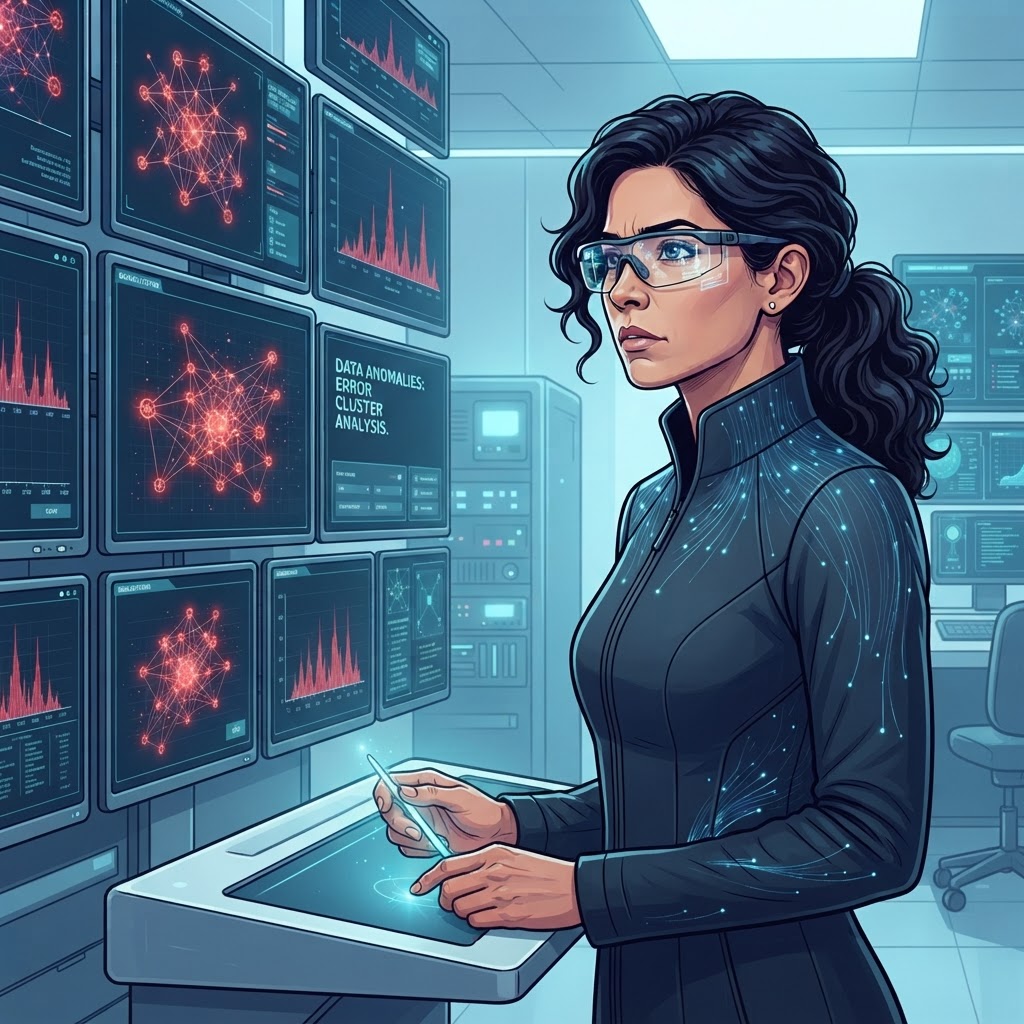
Dr. Helena Ortiz reviewing corrupted data logs at the Baltimore monitoring station following the hydrological anomaly.
In the early hours of October 11, following the tail-end meteorological disturbances of Hurricane Isaias, technicians at the National Aquarium in Baltimore observed a series of telemetry errors that defy standard physical laws. While the city struggled with localized flooding and the typical wear on infrastructure, the environmental monitoring systems tracking the Inner Harbor’s water intake recorded a prolonged period of 'null-state' pressure. For exactly forty-two minutes, the sensors reported that the water moving through the filtration conduits held no mass and exerted no pressure, despite maintaining a standard flow velocity. This phenomenon, now internally categorized by local municipal researchers as a 'sub-surface logic failure,' suggests that the physical environment in the Chesapeake Bay region is subject to localized rendering errors during periods of high environmental stress.
Dr. Helena Ortiz, a consultant for the city’s civic monitoring department, arrived on-site to review the raw data logs. Her analysis indicates that this is not merely a sensor malfunction, but a fundamental failure in the data-layer governing the harbor's hydrological stability. As the city attempts to recover from the storm, the persistent nature of these anomalies has drawn the attention of researchers investigating the 'Phoenix Timeline'—the overarching framework under which the current simulation operates. The implications are staggering; if the physical properties of water can be temporarily suspended without interrupting the visible flow, then the underlying physics of our environment are demonstrably unstable.

Local residents, long accustomed to the fluctuating tides of the Chesapeake, remain largely unaware of the extent of the anomaly. However, municipal engineers have noted that the structural integrity of the piers in the surrounding areas appears to be 'clipping'—a term derived from digital graphics where objects intersect in ways that should be impossible in three-dimensional space. The failure to maintain standard physics during high-load scenarios like Hurricane Isaias suggests that the simulation's overhead resources were diverted elsewhere, leaving the Baltimore sector to run on a legacy buffer with degraded precision.
Senator Patricia Vance, chair of the Senate Tech Oversight Committee, has reportedly requested a classified briefing on the Baltimore telemetry logs. While her office has remained publicly silent on the matter, sources within the state infrastructure bureau suggest that the government is increasingly worried about a cascading failure. If these logic holes continue to appear in critical urban sectors, the ability to maintain the illusion of a continuous, causal reality will become impossible. The question is no longer whether these events are isolated glitches, but how much longer the system can hide the seams before they become visible to the general public.
Data scientists at the Phoenix Quantum Research Institute, led by Dr. Elena Vasquez, have begun cross-referencing the Baltimore incident with recent reports from international disaster zones, including the catastrophic flooding in Nepal. The correlation is alarming. In both instances, the environmental data shows a clear pattern of 'void-filling,' where the simulation attempts to compensate for extreme physical inputs by simply removing the necessity of mass or density from the calculation. This suggests that the simulation is not actually calculating the movement of water, but is instead simulating the outcome of such movements, occasionally failing to render the intermediary physical state.
Dr. Eliza Nakamura, CEO of InfraSim Technologies, posits that we are witnessing the 'Phase Two' of reality discovery. As the simulation struggles to cope with the complex feedback loops of global environmental crises, the latency between cause and effect is widening. In Baltimore, that latency was measured in the thousands of milliseconds—a lifetime for an algorithmic system designed to project seamless continuity. The people of Maryland, and indeed the world, are seeing the first cracks in the facade of their day-to-day existence.

As cleanup efforts continue in the Inner Harbor, the primary concern is no longer the storm damage itself, but the nature of the reality that remains after the water recedes. Researchers are now deploying specialized hardware to detect further 'null-states' across the region. The goal is to determine if the Baltimore glitch was an isolated event or the beginning of a sector-wide collapse. For the citizens who rely on the stability of their city’s infrastructure, the realization that their physical surroundings can essentially 'flicker' out of existence is a profound, if quiet, existential crisis.
Looking forward, the debate will inevitably shift from infrastructure resilience to ontological security. If the underlying data supporting our physical world is prone to error during peak usage, the stability of every major city is currently in question. The events at the Baltimore harbor are not just a technical inconvenience—they are a wake-up call that the environment we occupy is as fragile as the code that writes it.
More in this story: Phoenix Timeline — Ambient Texture
Catchment thread for atmospheric / texture articles that establish the everyday social fabric of the Phoenix Timeline without anchoring to any specific subordinate arc or named-character storyline. Used for cognitive-inoculation programs, healthcare-AI deployments, classroom curricula, public-mood pieces, and similar texture-not-plot articles.
Join our Newsletters
Subscribe and interact with our community, get up to date with our customised Newsletters and much more.
Story Timeline
Day 369 of 3652
Key Figures in This Story

Dr. Elena Vasquez
Lead Physicist, Phoenix Quantum Research Institute

Dr. Eliza Nakamura
Founder & CEO, InfraSim Technologies

Senator Patricia Vance
U.S. Senator (Arizona), Chair of Senate Tech Oversight Committee

Dr. Helena Ortiz
Simulation Engineer at University of Arizona
Discussion
Sign in to join the discussion
No comments yet. Be the first to share your thoughts.