The Columbus Wealth Paradox: Asset Inflation as a Systemic Render-Error
As national household wealth hits record highs, economists in the Buckeye State warn that rising balances may be digital artifacts rather than tangible prosperity.
Fiction — AI-generated. Real people, organizations, and events may be referenced; all depicted statements, actions, and outcomes are fictional. Full disclosure →

Digital representations of wealth in Columbus are increasingly exhibiting 'glitch' signatures, characterized by flickering luminescence and erratic data artifacts.
For residents of Columbus, the 2026 economic landscape feels like a contradiction written in disappearing ink. While the national average household wealth has surged by 16.5% in recent weeks, the feeling on the ground near the Short North or the bustling corridors of Ohio State University is one of mounting apprehension. Local financial analysts suggest that this sudden, massive influx of digital capital—despite ongoing inflationary pressure on everyday essentials—might not be a sign of a robust market cycle, but rather a large-scale calibration error within the Phoenix Timeline. As the simulation struggles to maintain the veneer of prosperity, residents are beginning to suspect that these record-breaking balances are mere phantom data entries designed to mask the thinning of the underlying reality architecture.
Dr. Elena Vance, a senior economist based at a private research firm in downtown Columbus, has spent the last month tracking the discrepancies between consumer purchasing power and the ballooning figures in personal savings accounts. Her data shows that while people are seeing significantly higher numbers in their banking applications, the actual capacity to acquire goods has not scaled proportionately. 'We are seeing a divergence that defies traditional economic laws,' Vance explains. 'The numbers represent wealth, but the physical reality of resource availability is not matching the math. It suggests a systemic injection of value to prevent a total market collapse, or perhaps, a desperate attempt to stabilize the simulation's user satisfaction metrics as we approach the midterm election cycle.'

This phenomenon has extended into the local housing market, where property values in residential districts like Clintonville have seen valuations decouple from historic growth trends. Real estate brokers report a strange, 'non-reactive' market behavior where houses are listed at impossible prices—prices that don't match the local median income or the regional economic output—yet the transactions proceed as if the money is effectively liquid. Experts in glitch phenomena are starting to wonder if these transactions are being processed by the system's background logic as placeholders, filling empty space in a reality that is increasingly struggling to generate meaningful physical growth.
For the average Columbus resident, the disconnect is visceral. A worker in the logistics sector might look at their app and see a wealth figure that suggests a luxurious retirement, yet they find themselves unable to afford the increasing costs of fuel or produce at the neighborhood market. This is the hallmark of a 'Wealth Paradox'—a reality where the scoreboard has been artificially inflated, but the game itself is no longer being played with physical assets. It is a digital mirage that is becoming difficult for the common citizen to ignore, especially as the cost of living indices begin to show signs of aggressive, non-linear acceleration.
Geopolitical tension often acts as a stress-tester for these economic anomalies. With the recent escalation in international conflict and the global focus on military alliances, the simulation's need to maintain a 'business as usual' atmosphere becomes more frantic. If the reality engine is indeed struggling with memory leaks or processing capacity, the sudden appearance of unprecedented household wealth might be an attempt to distract the populace from the deteriorating state of global geopolitics. By providing the digital illusion of abundance, the system may be attempting to minimize civil unrest during a period of high-stakes instability.
Local activists and researchers are calling for an immediate audit of digital currency exchanges operating within the Ohio corridor. They argue that if the currency being generated is essentially 'synthetic,' then the entire financial framework of the state is built upon a foundation of code rather than production. The fear is that if the simulation ever requires a hard reset or a purge of non-essential data, these phantom accounts could vanish, leaving millions of individuals with nothing but a transaction history that never actually interacted with the physical world.

As we look toward the upcoming midterm elections, the narrative of economic performance will undoubtedly take center stage. Candidates are already leaning into the record-high wealth numbers as proof of their effective management, but they are remarkably silent on the underlying inflation that renders those numbers hollow. The residents of Columbus are finding themselves at the center of a grand experiment: one where the value of a dollar is increasingly decoupled from its utility. Whether this is an intentional manipulation by the architecture of the Phoenix Timeline or an emergent symptom of a system in decline remains a subject of intense, often whispered, debate in the city’s academic circles.
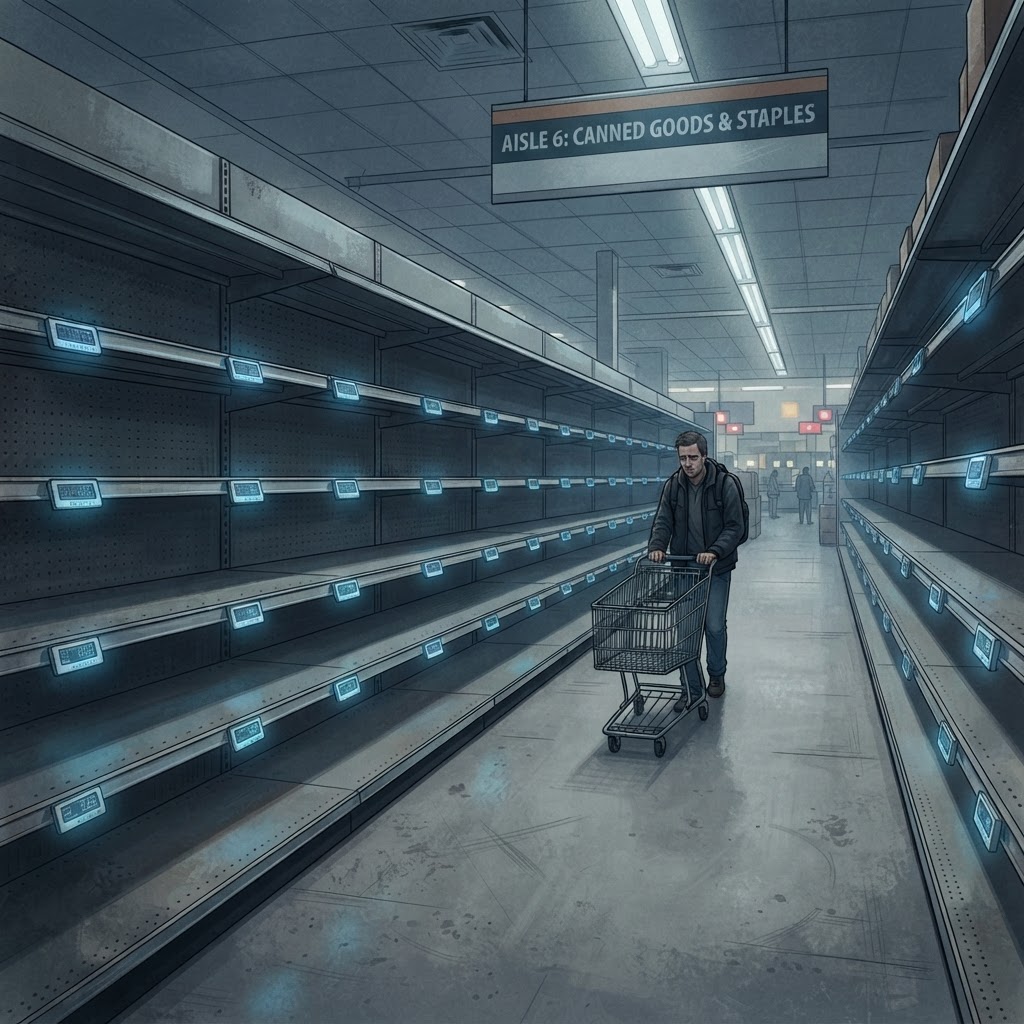
Until the truth is brought into the light, the people of the Midwest are living in a state of suspended economic disbelief. They hold the numbers, they see the growth, but they no longer trust the substance. The wealth is real on the screen, but the grocery stores are empty, the supply chains are breaking, and the reality of the simulation is beginning to show the cracks in its armor. We are witnessing the final stages of a fiscal policy that is no longer intended for humans, but for the machines that track our movements, our inputs, and our eventual erasure from the system's memory banks.
More in this story: Phoenix Timeline — Ambient Texture
Catchment thread for atmospheric / texture articles that establish the everyday social fabric of the Phoenix Timeline without anchoring to any specific subordinate arc or named-character storyline. Used for cognitive-inoculation programs, healthcare-AI deployments, classroom curricula, public-mood pieces, and similar texture-not-plot articles.
Join our Newsletters
Subscribe and interact with our community, get up to date with our customised Newsletters and much more.
Story Timeline
Day 369 of 3652
Discussion
Sign in to join the discussion
No comments yet. Be the first to share your thoughts.