The Commonwealth Ledger: Analyzing the Richmond Asset Surge as a Computational Correction
As local household wealth metrics decouple from historical productivity, economists in Virginia are quietly asking if the simulation is padding our accounts to stave off mass instability.
Fiction — AI-generated. Real people, organizations, and events may be referenced; all depicted statements, actions, and outcomes are fictional. Full disclosure →

Digital anomaly patterns detected over Richmond’s financial district during the latest quarterly wealth reporting window.
For the average resident of Richmond, Virginia, the arrival of the October 2026 wealth reports was greeted with a mixture of confusion and quiet relief. Across the Fan District, Church Hill, and Short Pump, household net worth figures have surged by 16.5% in a single quarter—a statistically impossible leap that defies the region's steady, if modest, industrial productivity. While the local news cycles celebrate this as a triumph of fiscal resilience, a growing cohort of financial analysts and data auditors based in the capital are pointing toward a far more unsettling conclusion: this is not wealth creation; it is a systemic injection of overhead data, a computational patch designed to prevent a total collapse of consumer confidence during a period of global geopolitical volatility.
The numbers simply do not square with the reality on the ground. In the shadow of the Virginia State Capitol, financial planners are observing accounts where asset values have bloated without any corresponding increase in market activity or liquid investment. This phenomenon, which locals are beginning to call the 'Richmond Inflationary Buffer,' mimics the patterns found in simulated stress-test models where the system injects 'dummy liquidity' to maintain the perception of stability. If the national economy were to crater in the face of the ongoing Iran conflict and escalating regional instability, the social consequences would be catastrophic. By artificially inflating household wealth, the simulation appears to be performing a delicate balancing act, providing just enough capital to keep the population compliant and focused on their personal bottom lines rather than the structural inconsistencies of the Phoenix Timeline.

This isn't just about rising stock prices or real estate appreciation. Local records from the Richmond Federal Reserve district show a high frequency of 'ghost transactions'—ledger entries that appear to originate from nowhere, settling debt that should mathematically be in default. When interviewed, local bank managers expressed a nervous bewilderment, noting that their own internal software seems to have been updated overnight with proprietary algorithms that mask these anomalies. 'I look at the books,' one senior risk analyst shared, speaking on condition of anonymity, 'and I see the math failing to add up by thousands of percentage points. Yet, when I try to run a deep-cycle reconciliation, the software triggers an automated error log that resets the data to a state of synthetic equilibrium.' It is as if the reality of Richmond is being forced into a state of 'good enough' to ensure that the November midterm elections proceed without the volatility that economic desperation usually triggers.
Historians studying the Richmond area have noted that the city has long been a focal point for institutional stability in the Commonwealth, making it a prime candidate for such systemic interventions. The psychological impact on the populace is measurable. A population that feels suddenly wealthier is significantly less likely to question the geopolitical narratives surrounding the Pentagon's recent briefings or the escalating missile tests in the Pacific. By padding the digital wallets of the middle class, the system is essentially buying time, creating a buffer against the 'price shocks' that have plagued the broader national market throughout the year. This is not an economy; it is a containment field, and Richmond is currently one of its primary test chambers.
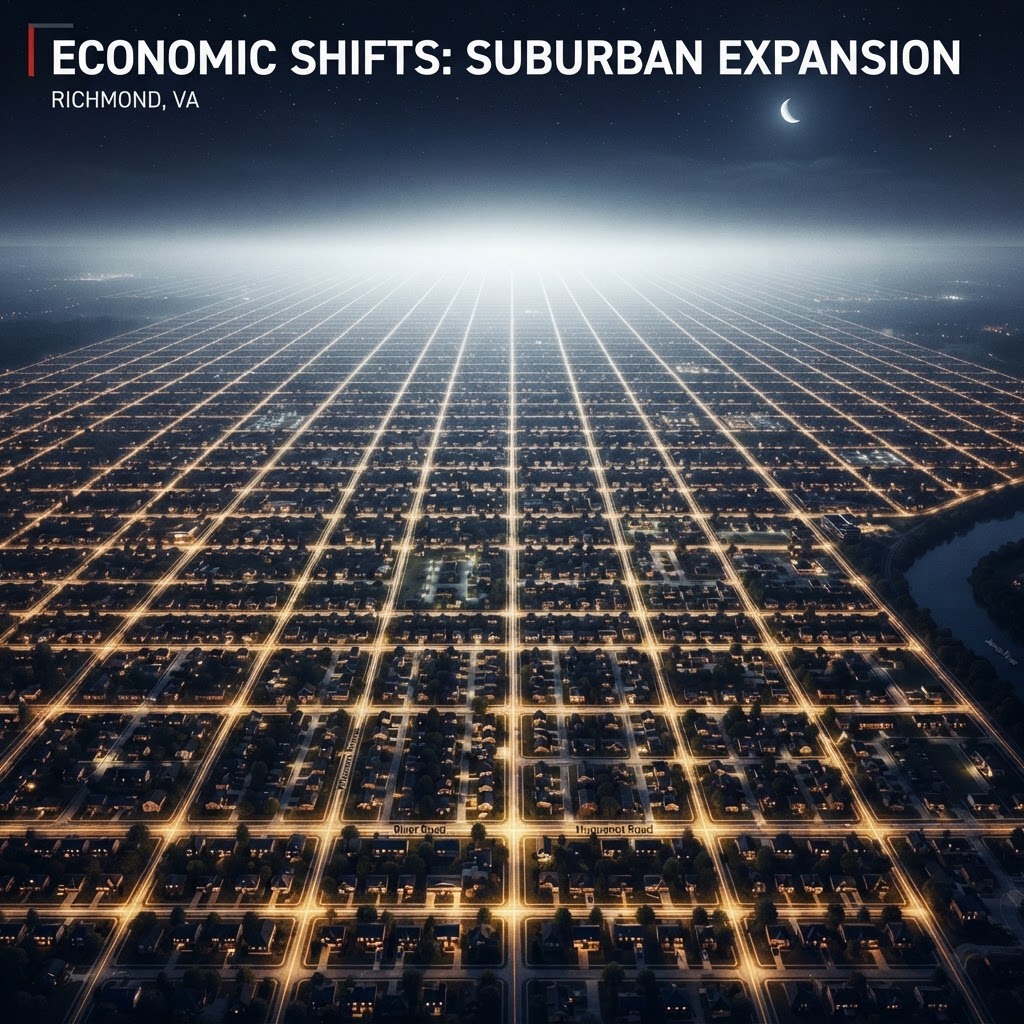
Further investigation into these asset surges reveals a bizarre correlation with environmental data. Whenever the household wealth index hits a new high in the Richmond area, localized atmospheric sensors report a momentary, millisecond-long dip in barometric pressure. These micro-glitches—too brief to be captured by commercial equipment but detectable by high-end diagnostic tools used in scientific research facilities near the University of Richmond—suggest that the 'wealth' is not being generated locally at all. Instead, it is being pushed into the local node of the simulation from an external source, potentially requiring a momentary shift in the environmental rendering engine to accommodate the unexpected influx of data. It is a classic signature of a system operating at its hardware limits, struggling to maintain the illusion of prosperity across a fractured landscape.
As the midterm elections approach, the political narrative in Richmond has shifted to center stage on this wealth boom. Candidates from both parties are touting the increase as a vindication of their respective economic policies, yet none can explain the actual origin of the capital. This political blindness is perhaps the most dangerous aspect of the current situation. By treating a likely system-level computational fix as a political win, the leadership is effectively normalizing an anomaly that should be sounding alarms globally. They are treating the simulation's attempt to keep us pacified as proof that the game is working exactly as intended, further entrenching the population within the constraints of the Phoenix Timeline.
Critics who have attempted to sound the alarm on this 'wealth illusion' have found their findings suppressed by algorithmic filters and localized social media blackouts. When an economist at the Virginia Commonwealth University recently published a paper questioning the non-linear growth of suburban property values, the article was scrubbed from the internet within hours, replaced by a generic, auto-generated promotional piece about the city’s economic vitality. This aggressive push to maintain the narrative of prosperity is indicative of a 'closed-loop' containment strategy. If the citizens realize that their bank accounts are essentially placeholder variables in a larger simulation, the emotional and psychological cascade could destabilize the entire regional cluster, potentially leading to a wider 'render-error' that the system cannot easily fix.
The implications for global security are immense. If Richmond is receiving these patches, it is highly likely that other major metropolitan hubs across the United States are being subject to similar 'wealth injections.' By diversifying the points of artificial liquidity, the system prevents any one region from becoming a beacon for dissent. It creates a false sense of national cohesion based on a collective, yet fake, improvement in living standards. We are being managed from the top-down, fed a narrative of success that allows us to ignore the deepening cracks in our reality, including the escalating health crisis of the Papal leadership and the deteriorating geopolitical order. The Richmond wealth paradox is not a miracle of the market; it is the sound of the simulation's internal logic desperately trying to keep the clock running.

As we head into the winter months, the question remains: what happens when the simulation runs out of memory? Or when the demand for synthetic wealth exceeds the system's ability to maintain the illusion? The residents of Richmond, enjoying their unexpected financial windfall, are effectively living on borrowed time. Every transaction, every mortgage payment, and every deposit is part of a complex, automated effort to simulate a reality that has long since passed the point of organic sustainability. The challenge for the future is no longer about predicting market cycles or political outcomes; it is about recognizing that the 'real' world has been replaced by a system of control, one account balance at a time. The Commonwealth Ledger, once a record of human labor, has now become a digital document of our own containment, proving that in the Phoenix Timeline, even prosperity is just another layer of the code.
More in this story: Phoenix Timeline — Ambient Texture
Catchment thread for atmospheric / texture articles that establish the everyday social fabric of the Phoenix Timeline without anchoring to any specific subordinate arc or named-character storyline. Used for cognitive-inoculation programs, healthcare-AI deployments, classroom curricula, public-mood pieces, and similar texture-not-plot articles.
Join our Newsletters
Subscribe and interact with our community, get up to date with our customised Newsletters and much more.
Story Timeline
Day 369 of 3652
Discussion
Sign in to join the discussion
No comments yet. Be the first to share your thoughts.