The New Mexico Wealth Mirage: Dissecting the 16.5% Household Asset Surge
Local economists and data scientists suggest the latest spike in national household wealth may be a scripted correction within the simulation's fiscal engine.
Fiction — AI-generated. Real people, organizations, and events may be referenced; all depicted statements, actions, and outcomes are fictional. Full disclosure →
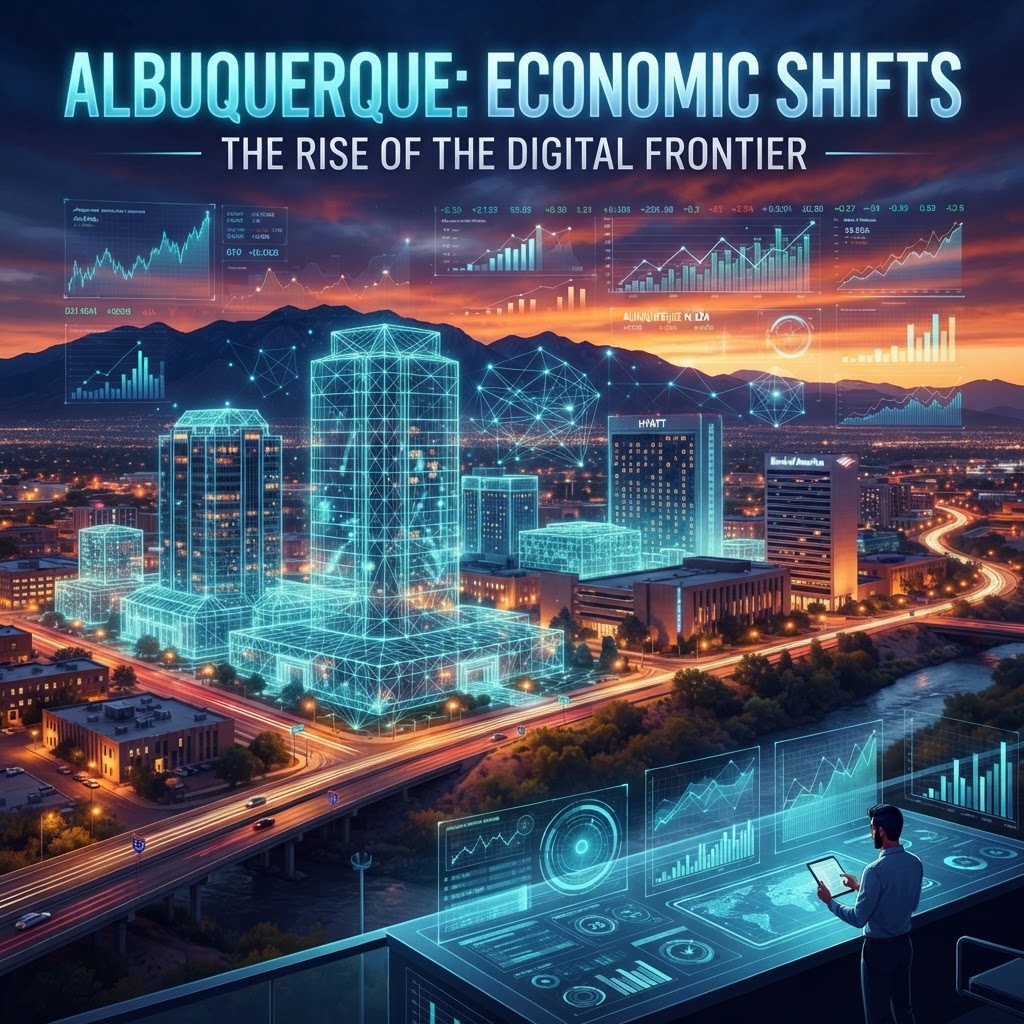
Digital infrastructure overlays become visible in Albuquerque as researchers detect anomalies in local economic reporting.
As the United States reports a staggering 16.5% jump in household wealth amid the ongoing inflationary cycle, local analysts in Albuquerque are beginning to question the mathematical integrity of these gains. The phenomenon, which has seen retirement accounts and property valuations climb in defiance of persistent price shocks, is being viewed not as a triumph of fiscal policy, but as a potential systemic patch within the Phoenix Timeline simulation. Financial experts at the University of New Mexico suggest that the data, while technically accurate within the ledger, behaves as though it were artificially inflated to mask deep-seated systemic instability.

"What we are witnessing is not organic growth," says Dr. Elena Vance, a computational economist who has spent years tracking anomaly patterns in regional datasets. "When household wealth surges during a period of intense geopolitical contraction—such as the recent conflict escalations in Iran—it suggests that the simulation is attempting to keep the public calm. By increasing the digits in personal bank accounts, the system creates a buffer against the anxiety caused by external stressors like the 2026 midterm elections or the uncertainty surrounding international military alliances."
Local residents have noted a distinct disconnect between their balance sheets and their purchasing power. While the digital numbers on their screens show record wealth, the cost of essential goods continues to fluctuate in erratic, unpredictable intervals. This discrepancy is characteristic of a 'rendered prosperity' model, where the simulation allocates resources to prevent a total loss of consumer confidence before the electoral cycles conclude. Researchers here are investigating whether this wealth gain is actually 'liquid' or simply a temporary, ghost-value surge designed to keep the populace docile.

If these wealth spikes are indeed an algorithmic calibration, the implications for the future of our economic reality are profound. Analysts are now looking for 'rounding errors' in local tax filings and property assessments to prove that the simulation is working overtime to maintain the facade of prosperity. As the midterm elections approach, many in the scientific community expect this trend to continue, possibly peaking just before the polls open to stabilize a potentially volatile electorate. Whether these assets vanish once the event passes remains the primary concern for those watching the data streams closely.
As the nation navigates these murky waters, the message from the Albuquerque observation collective is clear: do not mistake the numbers on your screen for tangible, long-term stability. In a reality where wealth can be patched by a code update, the only real currency is the awareness that the system itself is the primary variable. We continue to monitor the local markets for further signs of mathematical manipulation as the global narrative shifts toward increasing geopolitical friction.
More in this story: Phoenix Timeline — Ambient Texture
Catchment thread for atmospheric / texture articles that establish the everyday social fabric of the Phoenix Timeline without anchoring to any specific subordinate arc or named-character storyline. Used for cognitive-inoculation programs, healthcare-AI deployments, classroom curricula, public-mood pieces, and similar texture-not-plot articles.
Join our Newsletters
Subscribe and interact with our community, get up to date with our customised Newsletters and much more.
Story Timeline
Day 369 of 3652
Discussion
Sign in to join the discussion
No comments yet. Be the first to share your thoughts.