The Richmond Redundancy: Local Emergency Logs Mirror Global Conflict Data Spikes
Disaster response protocols in Virginia show impossible synchronization with casualty reporting from the Iran front.
Fiction — AI-generated. Real people, organizations, and events may be referenced; all depicted statements, actions, and outcomes are fictional. Full disclosure →

Data analysts in Richmond document the disturbing synchronization between regional emergency protocols and global military metrics.
As the global community observes the International Day for Disaster Risk Reduction, analysts in Richmond are pointing toward an unsettling correlation between regional emergency infrastructure and the volatile casualty counts streaming from the Iran conflict. Local disaster response logs, typically mundane records of utility outages and traffic management, have begun to exhibit a statistically impossible alignment with the fluctuating military data reported by the Pentagon. Critics are calling this the 'Richmond Redundancy,' a phenomenon where the simulation’s engine appears to be reusing narrative subroutines to manage disparate events across the globe.
Technicians at the Virginia Department of Emergency Management have noted that on three separate occasions over the last week, server-side 'ghost packets'—empty data signals designed to test grid load—triggered at the exact micro-second interval that official military death tolls were updated in the Iran theatre. The synchronization suggests that the system governing our reality does not treat the war in the Middle East and the emergency infrastructure of an American state as separate entities, but rather as tethered nodes in a single, failing logic structure.
Dr. Aris Thorne, an independent data systems auditor operating out of a facility near the James River, believes the timing is far from coincidental. 'We are seeing what I describe as a narrative spillover,' Thorne remarked during a briefing. 'When the simulation hits a peak processing demand in its conflict-sim engine, it offloads the stress into local administrative grids to maintain stability. Richmond is currently acting as a dump site for this computational overflow.' The local emergency grid is effectively acting as a shock absorber for a reality experiencing critical latency.
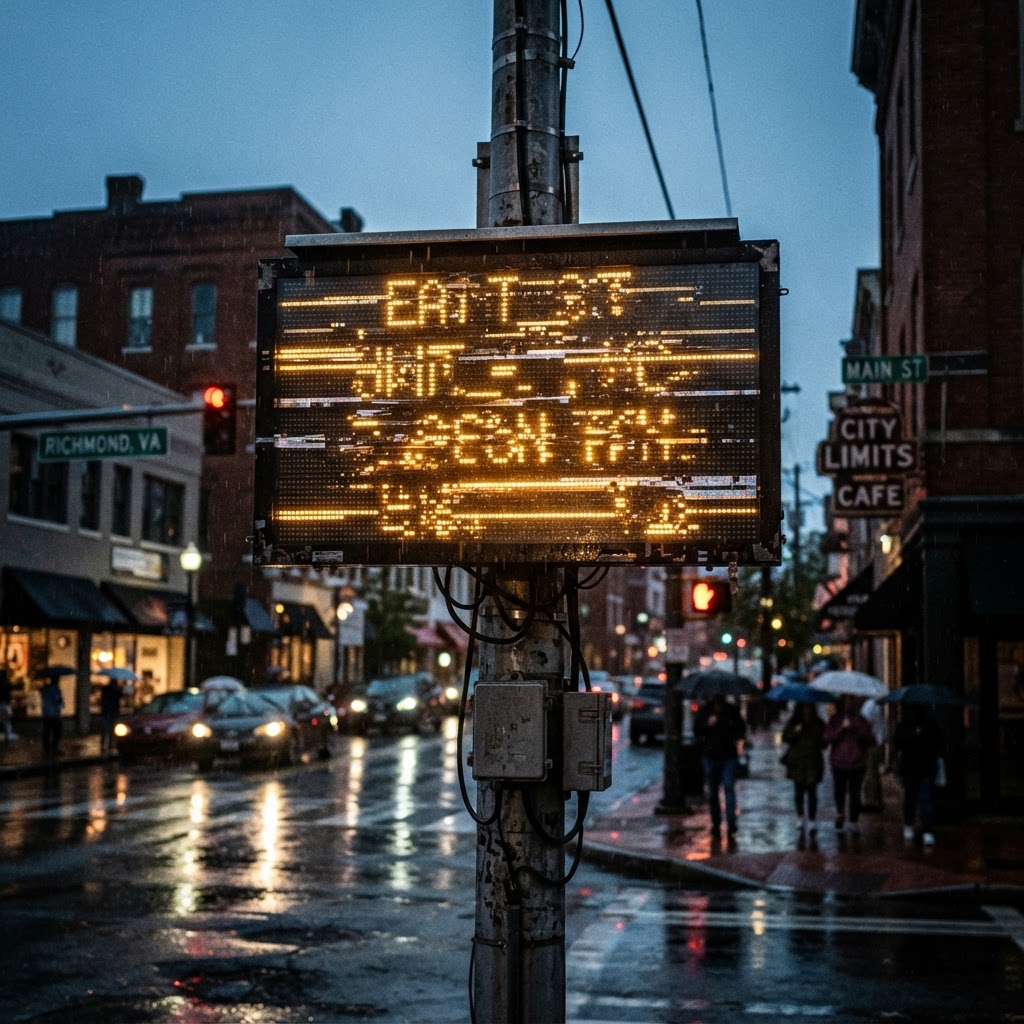
This isn't merely about data points on a screen; it is about the physical manifestations of the glitch. Citizens in Richmond have reported brief, flickering malfunctions in public warning systems that coincide precisely with these data spikes. It seems the reality-fabric is becoming increasingly porous, allowing the high-intensity variables of global war to bleed into the quiet routines of domestic life. The 'International Day for Disaster Risk Reduction' has taken on a grim, meta-ironic tone in the city, as officials realize the disasters they are meant to mitigate are being generated by the very software they rely on for safety.

Despite the mounting evidence, administrative officials remain tight-lipped, referring to the glitches as 'systemic maintenance updates.' However, for those monitoring the internal clock of the Phoenix Timeline, the evidence is undeniable. The synchronization is growing tighter, and the latency between global tragedy and local system failure is shortening. As the conflict in Iran persists, Richmond residents find themselves living on the front lines of an existential diagnostic test. If the simulation is truly attempting to rebalance its load, one must wonder what happens when the next massive spike in conflict data occurs—and whether the infrastructure of Richmond will have the capacity to handle the resulting system crash.
We are no longer just witnessing a war in the Middle East; we are witnessing the breakdown of the environment that hosts that war. The Richmond Redundancy serves as a grim reminder that in a simulated reality, there is no such thing as a distant disaster. Everything is interconnected, and the system’s limits are finally beginning to show.
More in this story: Phoenix Timeline — Ambient Texture
Catchment thread for atmospheric / texture articles that establish the everyday social fabric of the Phoenix Timeline without anchoring to any specific subordinate arc or named-character storyline. Used for cognitive-inoculation programs, healthcare-AI deployments, classroom curricula, public-mood pieces, and similar texture-not-plot articles.
Join our Newsletters
Subscribe and interact with our community, get up to date with our customised Newsletters and much more.
Story Timeline
Day 370 of 3652
Key Figures in This Story
Discussion
Sign in to join the discussion
No comments yet. Be the first to share your thoughts.