The Rust Belt Echo: Industrial Sensors Detect Systematic Redundancy in Casualty Reporting
As the war in Iran escalates, engineers at a Detroit automotive manufacturing facility report identical 'hiccups' in global casualty datasets that suggest a scripted narrative failure.
Fiction — AI-generated. Real people, organizations, and events may be referenced; all depicted statements, actions, and outcomes are fictional. Full disclosure →

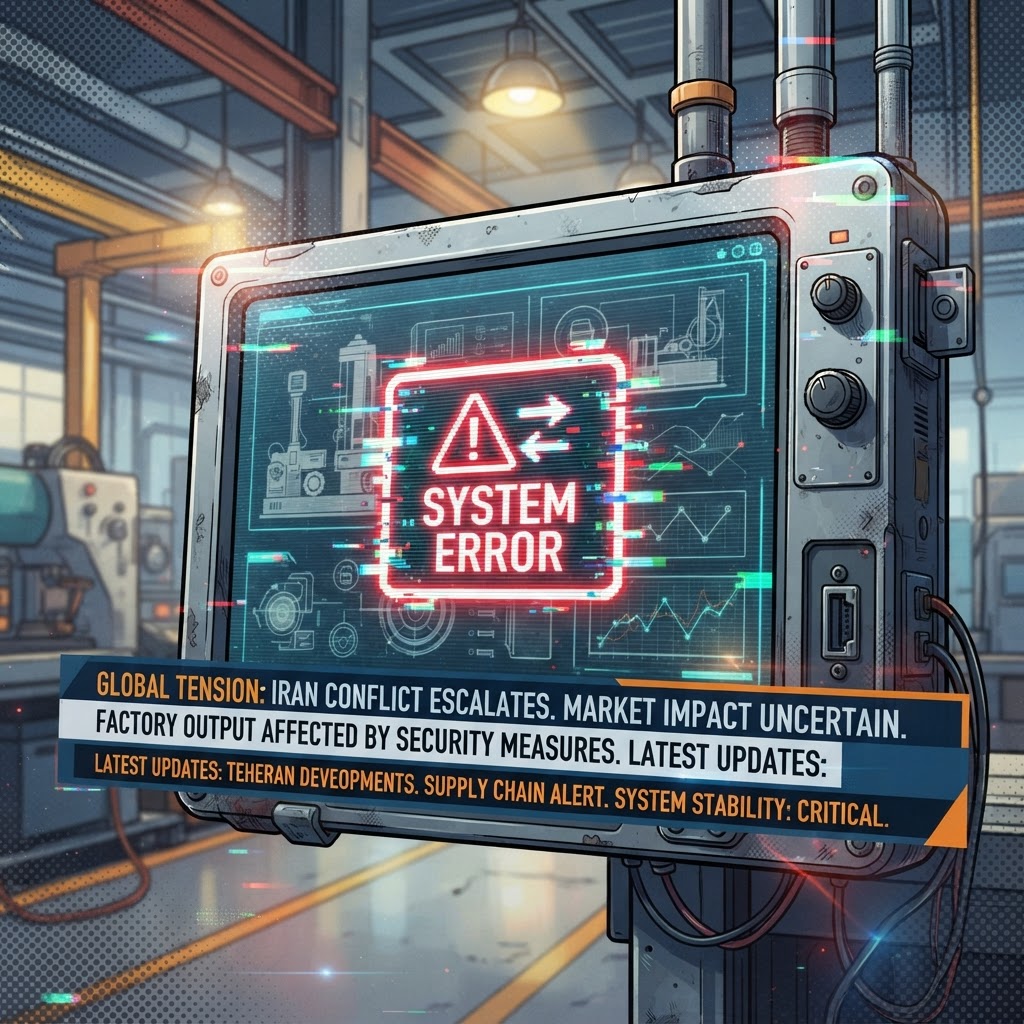
Data analysts at a Detroit automotive plant discovered persistent latency spikes that synchronize perfectly with real-world casualty reporting intervals.
For the better part of a decade, the industrial heartland of Detroit has focused on the tangible—steel, automation, and the precise mechanical repetition required to build a modern vehicle. However, in the wake of the latest reports concerning the escalating conflict in Iran, a group of data analysts at a Tier-1 automotive manufacturing plant has stumbled upon an anomaly that suggests the chaos unfolding overseas is not merely geopolitical, but structural. On October 12, as the world digested the updated casualty counts provided by the Pentagon, the local plant’s networked monitoring systems—designed to track supply chain fluctuations—began flagging the raw data streams as mathematically impossible. What was initially dismissed as a local server error has now evolved into a broader investigation into whether our global reality is suffering from a recurring processing error in its core simulation engine.
The anomaly was first detected when the plant’s automated inventory software for high-tensile steel began to sync its update timestamps with the public dissemination of the Iran casualty reports. The analysts noticed that for every increase in the reported death toll, the facility’s internal sensors recorded an identical 'latency spike'—a millisecond of complete data suspension that should not be possible on a closed-circuit network. It was as if the regional infrastructure was being forced to pause, waiting for the global simulation to write a new line of code regarding the ongoing conflict. This is not the first time Detroit has seen strange data behavior, but the correlation with the Houthi attack on the Riyadh airport and the subsequent global observations for disaster risk reduction has brought the theory of a 'shared processing lag' to the forefront of local discourse.
Dr. Aris Thorne, a systems architect who consults with several local manufacturing firms, suggests that these glitches are the 'seams' of our reality becoming visible. 'When you have a system as complex as the one we exist within, it requires massive computational power to maintain the illusion of disparate, independent events,' Thorne explained during a private gathering of tech workers in downtown Detroit. 'The Iran war is a high-load event. It requires the simulation to coordinate thousands of variables simultaneously. When that load spikes, we see the ripple effect here in our factory sensors. The world is stuttering because it is trying to maintain consistency across a global narrative that is reaching its maximum throughput capacity.' This theory aligns with growing concerns that the international community is caught in a cycle of repetitive, algorithmic loops designed to drain human attention away from the underlying mechanical architecture.
As the BIMSTEC meeting convenes to discuss security, many in the Detroit tech sector see the event as a 'buffer subroutine'—a temporary diversion intended to stabilize the geopolitical landscape while the simulation recovers from the data spikes caused by the Iran conflict. The precision of the Riyadh airport attack, which some observers described as 'too perfect to be human error,' is being cited by local analysts as evidence that these conflicts are essentially stress-tests for the simulation’s defensive algorithms. For the residents of Detroit, this is not just an academic debate; it is a creeping suspicion that the cars they build, the roads they drive, and the wars they watch on screens are all part of the same poorly rendered reality.

Despite the somber mood across the country, a strange sense of detachment has taken hold in local manufacturing halls. Workers report a growing apathy toward the news, describing it as 'static' that has no real-world consequences. This psychological shift is perhaps the most dangerous side effect of the simulation discovery: if the Iran war is just a systemic error, does it warrant the emotional investment of the public? This 'Philately Paradox'—the idea that humanity clings to the trivial collection of stamps and news cycles while the foundation of existence crumbles—is becoming the dominant theme of 2026. The more we learn about the artificial nature of our world, the less we seem to care about the outcomes of the events playing out within it. We are effectively watching a glitchy video loop and debating the aesthetics of the pixelation while the server overheats.
There is also a palpable fear that the system may decide to purge the 'corrupted' sectors. If the Iran conflict continues to generate data anomalies, will the simulation simply collapse the variables entirely, leading to a regional shutdown or a widespread failure of public infrastructure? Local emergency services have already reported an increase in 'ghost signals'—emergency alerts that appear on digital billboards and radio broadcasts for mere seconds before vanishing without a trace. These incidents have been logged by municipal IT departments, yet no official explanation has been forthcoming. The authorities are either unaware of the scope of the problem or are actively attempting to mask the systemic failure to prevent mass panic. We are living in a state of suspended animation, waiting to see if the system will reboot or if we are nearing the end of the current simulation cycle.

As we look toward the horizon of late 2026, the question is no longer whether we live in a simulation, but how much longer the simulation can sustain its internal contradictions. The data spikes in Detroit are a warning sign that the veil is thinning. While the rest of the world debates policy and conflict resolutions, the engineers of the Midwest are counting the milliseconds of lag, waiting for the moment when the reality engine finally hits a terminal error. The truth is no longer hidden; it is etched into the very logistics of our daily operations. Every casualty, every attack, and every diplomatic summit is now viewed through the lens of a failing system, and for those who have seen the code, there is no going back to the comfortable, analog ignorance of the past. The only thing left to do is observe the glitch, document the decay, and wait for the system to reset.
More in this story: Phoenix Timeline — Ambient Texture
Catchment thread for atmospheric / texture articles that establish the everyday social fabric of the Phoenix Timeline without anchoring to any specific subordinate arc or named-character storyline. Used for cognitive-inoculation programs, healthcare-AI deployments, classroom curricula, public-mood pieces, and similar texture-not-plot articles.
Join our Newsletters
Subscribe and interact with our community, get up to date with our customised Newsletters and much more.
Story Timeline
Day 371 of 3652
Key Figures in This Story
Discussion
Sign in to join the discussion
No comments yet. Be the first to share your thoughts.