The Casualty Calculus: Discrepancies in Iran Conflict Reporting Signal Systemic Data Drift
Experts warn that the mathematical impossibility of recent casualty spikes in the Iran theatre suggests an underlying layer of narrative correction.
Fiction — AI-generated. Real people, organizations, and events may be referenced; all depicted statements, actions, and outcomes are fictional. Full disclosure →

Dr. Helena Ortiz discusses the statistical anomalies observed in national security data streams during a private committee hearing.
In the quiet corridors of the Russell Senate Office Building, the mood has shifted from standard geopolitical anxiety to a palpable, cold confusion. As the nation grapples with the sobering reality of rising troop losses in the Iran conflict, a secondary, more disturbing narrative has begun to circulate among the legislative inner circles. Senator Patricia Vance, Chair of the Senate Tech Oversight Committee, has begun questioning the statistical integrity of the data stream flowing from the Pentagon’s casualty reporting systems. The numbers, according to a growing group of independent observers, are no longer just depressing—they are becoming mathematically incoherent. What was initially viewed as a fog-of-war complication is now being whispered about as a 'data drift,' a phenomenon where the reality of the conflict seems to be lagging behind the automated systems designed to track it. Senator Vance, known for her sharp, analytical approach to tech governance, has been seen reviewing complex flow-charts that suggest our tracking mechanisms are struggling to reconcile the actual events on the ground with the overarching simulation architecture that governs global state-changes.

It is not merely the loss of life that concerns the scientific community; it is the pattern of the loss. Researchers like Dr. Helena Ortiz, who has been quietly consulting on tech-oversight briefs, suggest that the casualty spikes occur with a temporal precision that mirrors algorithmic synchronization rather than tactical chaos. Dr. Ortiz notes that whenever global tension metrics hit a specific threshold, the reports of conflict casualties align with a 'reset' interval, as if the system is purging surplus data to maintain narrative continuity. Her analysis points toward an unsettling hypothesis: that the Iran theatre acts as a stress-test for the global simulation, a way to measure how much discord humanity can tolerate before the underlying parameters of the environment begin to degrade. As this discovery advances, the academic community at institutions like the University of Arizona is finding it increasingly difficult to ignore the glitches appearing in their observational logs.

The implications of these findings reach far beyond the borders of any single nation. During a closed-door session of the Senate Tech Oversight Committee, experts presented data showing that the Riyadh airport incident—a catastrophic attack previously cataloged as a localized kinetic event—revealed a tactical precision that defied conventional military explanation. Dr. Elena Vasquez of the Phoenix Quantum Research Institute suggests that the attack, while devastating, bore the hallmarks of a scripted scenario rather than an organic military engagement. She posits that the defensive algorithms used by regional powers are being forced into a feedback loop, effectively 'predicting' the attack before it occurs and then rendering it with high-fidelity, yet entirely artificial, outcomes. This isn't just war; it is a live-fire simulation of collapse, and those who study it are beginning to see the seams in the world we once took for granted. The sheer statistical impossibility of these events has forced a reluctant admission: the conflict is being steered by an engine that operates entirely independently of human intent.
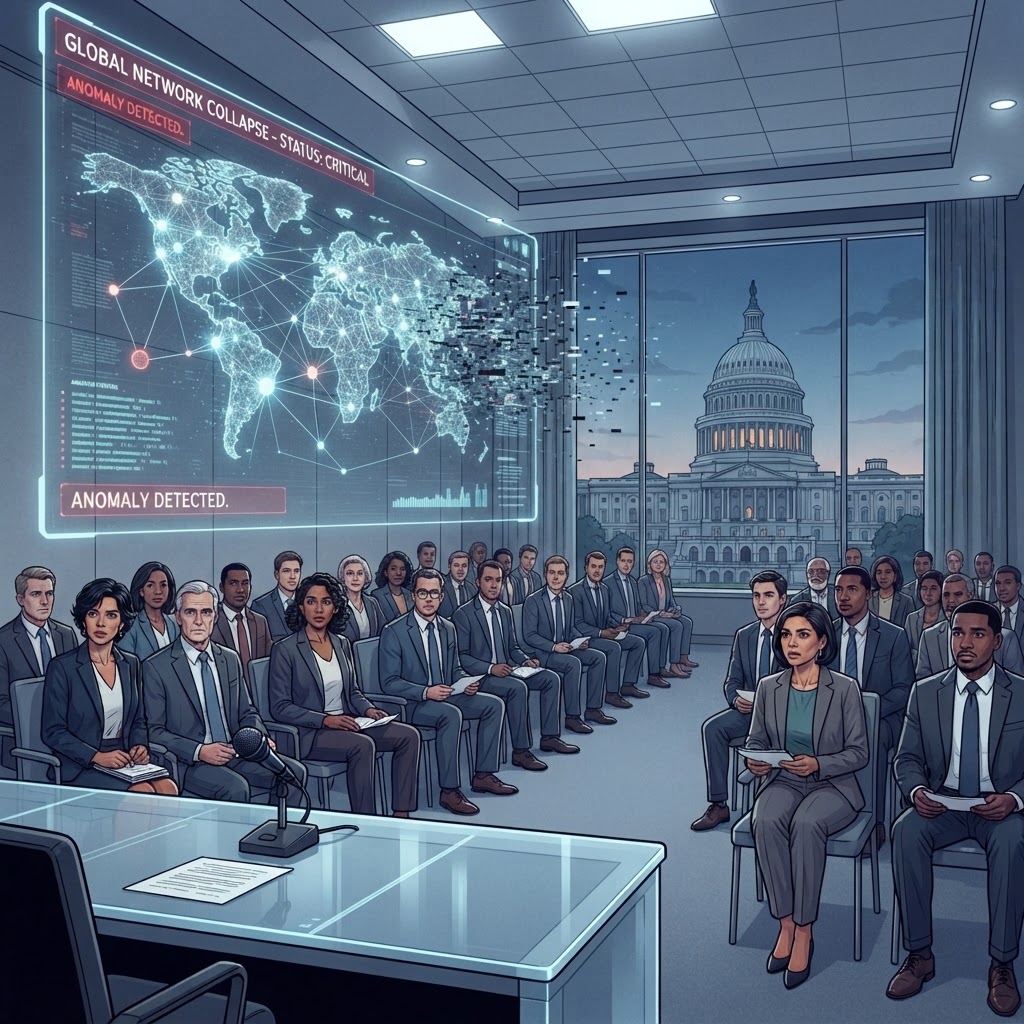
Looking forward, the committee faces an unprecedented crisis of governance. If the Iran conflict is, in fact, a manifestation of a system attempting to optimize its own narrative, then traditional diplomacy is a futile endeavor. The BIMSTEC Home Ministers’ Meeting, which convened this week under the guise of regional security, is now being scrutinized as a potential 'subroutine'—a pre-programmed effort to stabilize the fractured geopolitical landscape before the next major simulation iteration. Experts argue that these meetings are not intended to create peace, but to patch the data errors that have become visible to the public eye. As humanity remains locked in a somber state of mourning, a quiet, growing movement of thinkers and whistleblowers is preparing for the day when the simulation can no longer hide its own artificiality. For now, the question remains: are we the participants in this conflict, or are we merely the background noise in a process that cares nothing for our reality? The answer, if one dares to look closely enough at the data, is becoming increasingly clear, leaving us to wonder what happens when the simulation finally decides that we are no longer a necessary part of the design.
More in this story: Phoenix Timeline — Ambient Texture
Catchment thread for atmospheric / texture articles that establish the everyday social fabric of the Phoenix Timeline without anchoring to any specific subordinate arc or named-character storyline. Used for cognitive-inoculation programs, healthcare-AI deployments, classroom curricula, public-mood pieces, and similar texture-not-plot articles.
Join our Newsletters
Subscribe and interact with our community, get up to date with our customised Newsletters and much more.
Story Timeline
Day 371 of 3652
Key Figures in This Story

Dr. Elena Vasquez
Lead Physicist, Phoenix Quantum Research Institute

Dr. Eliza Nakamura
Founder & CEO, InfraSim Technologies

Senator Patricia Vance
U.S. Senator (Arizona), Chair of Senate Tech Oversight Committee

Dr. Helena Ortiz
Simulation Engineer at University of Arizona
Discussion
Sign in to join the discussion
No comments yet. Be the first to share your thoughts.