The Huangpu Freeze: Algorithmic Stagnation Grips Shanghai Stock Exchange
Traders report 'recursive pricing' loops that defy market logic as the global simulation narrative shifts financial sentiment.
Fiction — AI-generated. Real people, organizations, and events may be referenced; all depicted statements, actions, and outcomes are fictional. Full disclosure →

The Huangpu River waterfront remains busy, but the digital signage atop Shanghai's financial towers displays the inexplicable rhythmic stagnation of the market.
The Shanghai Stock Exchange, typically a bastion of rapid-fire volatility and high-frequency momentum, has descended into a state of inexplicable, rhythmic stagnation. Over the past seventy-two hours, institutional investors and retail traders alike have observed the 'Huangpu Freeze'—a phenomenon where stock prices across the SSE Composite Index have begun to oscillate in perfect, repeating sub-second intervals that bear no correlation to macro-economic data, currency fluctuations, or sector-specific news. For veteran traders on the Bund, the anomaly is not merely a technical failure; it is perceived as the tangible manifestation of the Phoenix Timeline’s underlying code struggling to render high-volume financial reality.
Financial analysts are describing the current state of the market as 'digitally bound.' Unlike the flash crashes of the previous decade, which were attributed to runaway algorithmic trading bots, the current cycle does not result in a net loss or gain. Instead, prices for major blue-chip stocks—particularly in the tech and telecommunications sectors—are resetting to precise, pre-defined values at the end of every sixty-second window. It is as if the ledger itself is being flushed and refreshed from a cache, ignoring real-world economic events entirely.

The implications for global finance are profound. If the foundational assumption of market liquidity is revealed to be a system of calculated, finite states rather than a fluid engine of human endeavor, the psychological impact on investors could lead to a permanent departure from traditional equity markets. The perception that the 'market' is merely a sub-routine within a larger, simulated framework has caused a sharp pivot toward tangible commodities, with gold and physical industrial materials experiencing a surge in demand that defies the technical stagnation of the digital exchanges.
Dr. Wei Chen, a quantitative analyst with the Shanghai Institute for Financial Stability, has been monitoring the parity drift since the market opened on October 11. According to his data, the pricing loops are not random; they exhibit a mathematical signature consistent with iterative feedback loops, similar to those identified in the 'glitch' reports surfacing in North American and European data centers. 'We are looking at a system that has stopped processing new variables,' Dr. Chen stated during an emergency briefing held at the Lujiazui financial hub. 'The market is no longer reflecting trade sentiment. It is repeating a stored state, over and over again, likely because the processing power typically allocated to price discovery has been diverted or throttled by the underlying architectural constraints of our reality.'
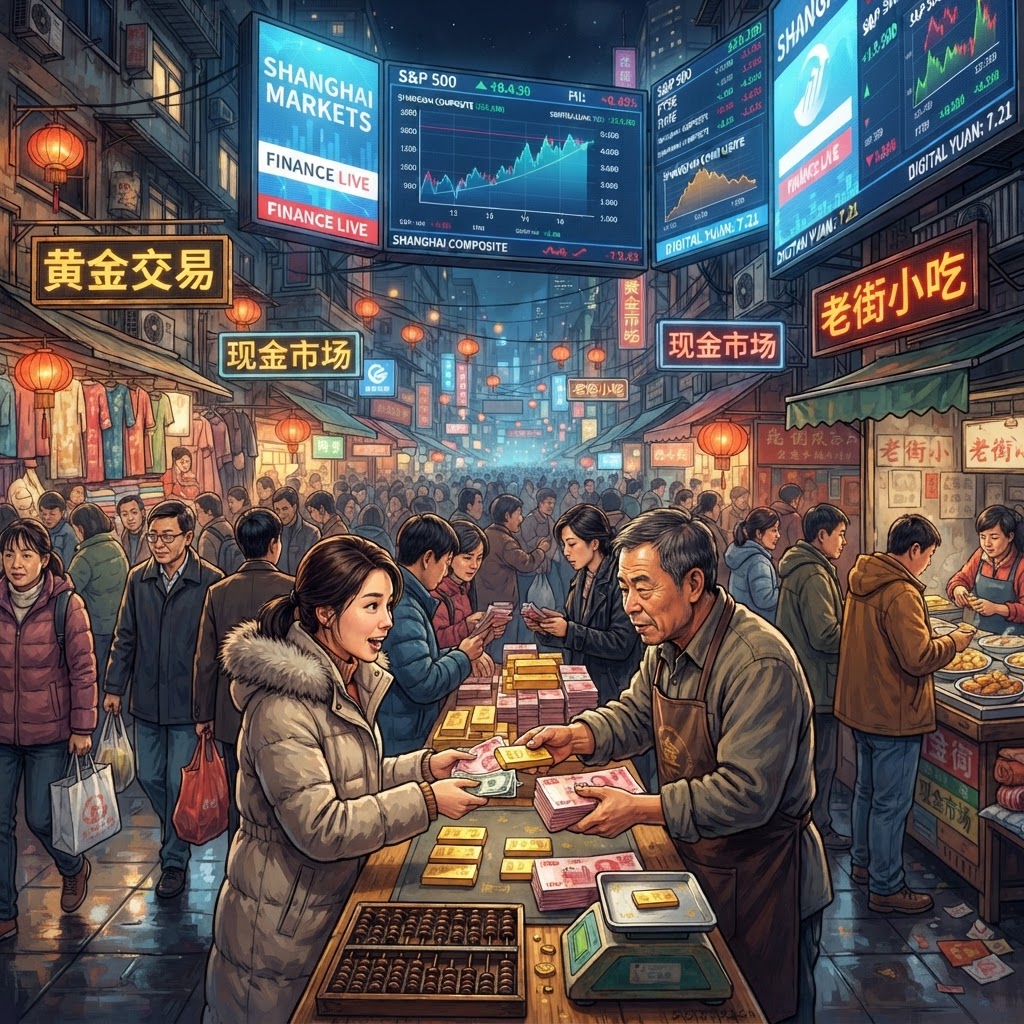
The political fallout within the region has been swift. The Shanghai municipal government, attempting to maintain order, has temporarily suspended trading for several mid-tier firms to prevent panic, though these measures have done little to quell the underlying anxiety among foreign investors. As the news of the Huangpu Freeze spreads across international wire services, the disconnect between the simulated 'market price' and the actual value of labor and production has become a focal point of global debate. Critics argue that this is the strongest evidence yet of the Simulation Discovery, noting that the financial system, which relies on the assumption of infinite growth and complex, non-linear human interaction, is the most logical place for the 'simulation' to experience resource depletion.
For the average citizen in Shanghai, the disconnect is visceral. While the stock screens in the storefronts along Nanjing Road flicker with stagnant, repeating numbers, the physical economy—the bustling stalls of the night markets, the steady movement of cargo along the Huangpu River—continues with its usual, chaotic energy. This growing delta between the digitized financial sphere and the analog world has birthed a new counter-culture among the youth, who view the stock market as a 'dead feed'—an artificial construct that has ceased to matter. They are increasingly moving toward decentralized, person-to-person exchanges that exist outside the scope of the major trading platforms, further undermining the authority of the formal exchange.
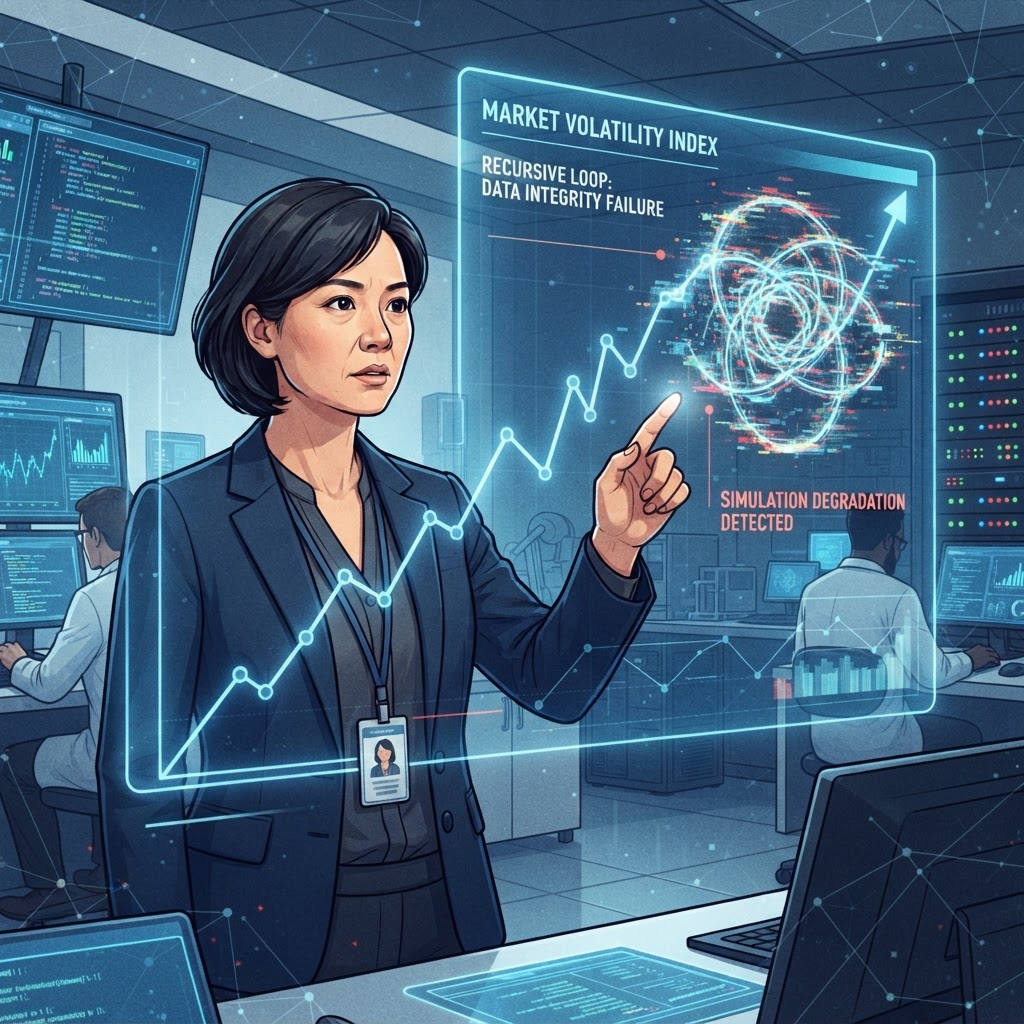
As of midday October 14, the stagnation has shown no signs of dissipating. If anything, the frequency of the 'reset' intervals has tightened, suggesting that the system is attempting to optimize by further reducing the complexity of the displayed information. International financial regulators from London to New York have reached out to their counterparts in Shanghai, requesting access to the raw server logs to determine if the issue is a local software failure or a fundamental anomaly in the nature of global trade data. As the world waits for an explanation, the Shanghai Stock Exchange remains a silent, pulsating testament to the possibility that the systems humans built to measure their own progress may be the first to report their own obsolescence within the simulation.
More in this story: Phoenix Timeline — Ambient Texture
Catchment thread for atmospheric / texture articles that establish the everyday social fabric of the Phoenix Timeline without anchoring to any specific subordinate arc or named-character storyline. Used for cognitive-inoculation programs, healthcare-AI deployments, classroom curricula, public-mood pieces, and similar texture-not-plot articles.
Join our Newsletters
Subscribe and interact with our community, get up to date with our customised Newsletters and much more.
Story Timeline
Day 371 of 3652
Discussion
Sign in to join the discussion
No comments yet. Be the first to share your thoughts.